

Table of Contents
- What to Check Before You Buy Copper Bars
- How to Spot Fake Copper Bars
- Is Buying Copper Bullion Worth It?
- Copper Bullion Storage Tips That Prevent Damage
- Understanding Premiums and Spot Prices
- Where to Safely Buy Copper Bars and Rounds
- Frequently Asked Questions
Last Updated: September 23, 2026
What to Check Before You Buy Copper Bars
Safe ways to buy copper bars start with one habit: verify the seller before the metal. Copper is cheap to fake and expensive to ship, so the dealer matters as much as the bar.
Run through this list before you send anyone money:
- Dealer reputation: Search for the business name plus "review" and read the last six months.
- Purity stamp: Look for ".999" or "fine copper" marked on the bar itself.
- Weight stated clearly: The listing should say grams or avoirdupois ounces, not just "large."
- Return policy: A written policy you can read before checkout.
- Insured delivery: Ask who covers a lost or stolen parcel.
- Payment method: Credit cards and traceable transfers beat wire-only sellers.
How to Spot Fake Copper Bars
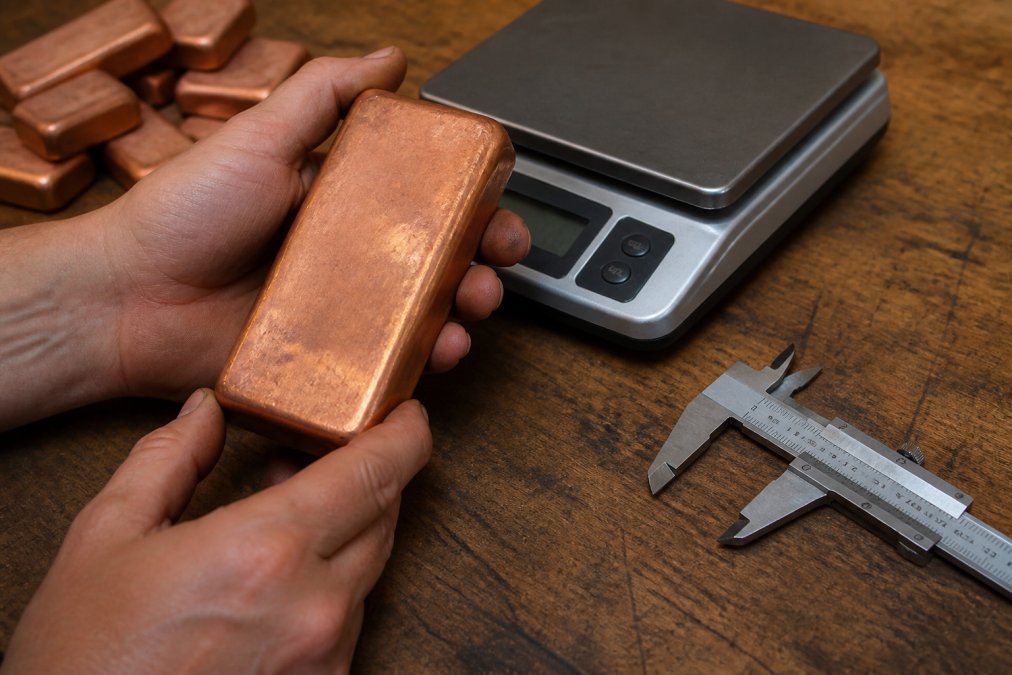
Fake copper bars are usually copper-plated steel or zinc, and they fail simple tests. A scale, a magnet, and five minutes will catch most of them.

Weight and Dimension Checks
Copper has a known density. A real 1 oz copper round weighs 31.1 grams in troy ounces, or 28.35 grams in avoirdupois ounces, check the listing to know which you are buying.
Magnet, Sound, and Acid Tests Explained
Copper is not magnetic. A strong magnet should slide off with no pull; if it sticks, you have steel inside.
Is Buying Copper Bullion Worth It?
Buying copper bullion is worth it for collectors and for low-cost entry into physical metals. It is not a wealth-building play, treat it as a hobby with a metal floor, not a retirement plan.
Here is the honest case for and against:
Pros:
- Low entry cost compared to gold or silver
- Easy to store and easy to hold
- Strong industrial demand keeps a floor under the metal
- Fun to collect in art bar and shaped formats
Cons:

- Heavy for the value it holds
- High premiums relative to the metal's worth
- Hard to sell back near spot in small amounts
- Space and weight make large holdings impractical
Copper vs. Gold and Silver: A Realistic Comparison
Copper is a base metal. Gold and silver are precious metals. That single difference drives everything else.
| Factor | Copper | Silver | Gold |
|---|---|---|---|
| Typical premium over spot | High | Moderate | Low |
| Value per kilogram | Low | High | Very high |
| Storage space needed | Large | Small | Very small |
| Industrial demand | Strong | Strong | Limited |
| Resale ease | Moderate | High | High |
| Best for | Collectors, beginners | Investors | Wealth storage |
Copper Bullion Storage Tips That Prevent Damage
Copper bullion storage tips come down to three things: dry air, low handling, and separation from other metals. Copper reacts with moisture and sulfur in the air. Left alone, it dulls.
Keep these habits:
- Leave colorized and proof-like pieces in their capsules
- Handle raw bars with cotton gloves
- Store bars in acid-free sleeves or a lined box
- Keep copper away from silver and gold to avoid transfer marks
- Check your stash every few months for new spots
Managing Tarnish and Oxidation
Tarnish on copper is a surface layer, not damage underneath. A dark or greenish film is oxidation and does not change the bar's weight or purity.
Understanding Premiums and Spot Prices
The spot price is the current market value of raw copper per pound or ounce. The premium is what you pay above that to own a finished bar, covering minting, packaging, shipping, and dealer margin.
How to Calculate the Premium You Are Actually Paying
(Bar price − (weight in troy oz × spot price per troy oz)) ÷ (weight in troy oz × spot price per troy oz) × 100 = premium %
Why Premiums Are the Real Risk in Copper
When you sell a copper bar back to a dealer, you are typically offered a buyback price below spot. That spread, what you paid (spot + premium) versus what you receive (spot − dealer spread), is where beginners lose money.
Investment Grade vs. Collectible Grade
Know which one you are buying:
- Investment grade: Plain bars and rounds, low premium, easy to resell
- Collectible grade: Art bars, shaped medals, colorized pieces, high premium, sold to collectors
Neither is wrong. They just serve different goals. If your plan is to sell later at a fair price, stay close to investment grade. If you want pieces you enjoy holding, the premium buys you that enjoyment.
Tax Treatment of Copper Bullion
Copper bullion does not receive the same tax treatment as precious metals. Under Canada Revenue Agency rules, copper is not a qualifying precious metal for the capital gains exemption that applies to certain gold, silver, and platinum coins and bars, so a gain on its sale is generally treated as a capital gain or ordinary income, depending on how the Canada Revenue Agency characterizes your activity.
Where to Safely Buy Copper Bars and Rounds
Safe places to buy copper bars and rounds are established dealers with clear policies, not marketplace listings from unknown sellers. The seller's track record is your main protection.
Look for these signals:
- A physical business address and contact details
- Written shipping and insurance terms
- A published return policy
- Clear product specs: weight, purity, and dimensions
- Traceable payment options
How to Verify a Dealer Before You Send Money
A dealer's website is marketing. Verification happens off the site. Run these checks in order:
- Business registration. Search the dealer's legal name in the provincial corporate registry or federal corporations database. A registered business has a paper trail; a sole proprietor under a trade name may not, which raises the burden on you.
- Physical address. Confirm it is a real commercial address, not a mailbox or a residential unit. Cross-check with a mapping service.
- Payment methods. Credit cards offer chargeback rights; Interac e-Transfer and wire transfers do not. A dealer accepting only untraceable payment is a red flag, not a convenience.
- Buyback policy. Ask in writing what the dealer will pay to buy the bar back, and under what conditions. A dealer that will not quote a buyback price is telling you the resale market is thin.
- Shipping and insurance. Confirm in writing before checkout who insures the parcel in transit, the claims process, and whether signature is required.
- Return window. A written return policy with a defined window and condition requirements is the minimum. "Contact us" is not a policy.
Liquidity: The Part Most Guides Skip
Liquidity is how easily you convert a bar back into cash without losing value. Copper is the least liquid common bullion metal, and that matters more than the purchase price.
- Dealers buy back investment-grade bars and rounds, typically at a discount to spot. The discount widens for colorized, shaped, and limited-mintage pieces, because the dealer must find a collector buyer, not just a metal buyer.
- Pawn shops and coin shops may buy copper at a steep discount or not at all, because the value per kilogram is low relative to the counter space it occupies.
- Private sales can get you closer to spot, but you carry the authentication burden and the risk of fraud or non-payment.
- Scrap yards buy copper by weight at scrap prices, not bullion prices, and will not care about your .999 stamp or limited mintage.
Industrial vs. Investment Grade
Not all copper is the same product. Scrap copper, electrical wire, and plumbing tube are industrial commodities sold by weight. Investment-grade bullion is refined to .999 fine, stamped with weight and purity, and sold in a finished format. They are not interchangeable, and a scrap yard price is not a bullion price.
Frequently Asked Questions
Where can I safely buy copper bars?
Buy from established dealers with clear return policies, published purity specifications, and insured shipping options. Check that listings state weight in avoirdupois ounces and purity as .999 fine copper. Independent reviews and a physical business address add confidence. Avoid marketplace listings with no certification or seller history. A reputable dealer will also explain what happens if your package is lost or stolen in transit, so ask before you order.
How do I verify the authenticity of copper bars?
Start with weight and dimensions: a genuine 5 oz or 10 oz bar should match its stated mass on a calibrated scale and its listed dimensions with calipers. Copper is not magnetic, so a strong magnet should not stick. Tap the bar and listen for a clear ring rather than a dull thud. For higher-value pieces, an acid test or X-ray fluorescence scan at a local dealer gives a definitive reading.
Is buying copper bullion worth it compared to gold and silver?
Copper costs far less per ounce, so you can build a large physical stack on a small budget. It also has genuine industrial demand. The trade-offs are bulk and lower liquidity: moving $500 of copper takes far more space than the same value in gold, and resale spreads tend to be wider. Many collectors treat copper as a low-cost entry point and a complement to precious metals rather than a replacement.
Are there specific storage considerations for copper bars?
Copper tarnishes when exposed to moisture, sulfur, and air. Keep bars in a dry space with stable temperature, ideally in sealed capsules, plastic sleeves, or a closed container with silica gel packets. Avoid bare shelves in humid basements or near kitchens and pools. Handle colorized or art pieces by the edges and store them separately from loose bullion to prevent scratches on the finish.
Copper is heavy, cheap to fake, and easy to store badly, which is why most beginner losses come from the seller and the shelf, not the metal. MMmetalsandmore helps you skip both problems with .999 fine copper bullion, a wide selection of collectible coins, and secure shipping on every order. Browse the copper range, check the specs on each listing, and buy with a dealer that stands behind the delivery. Get started with MMmetalsandmore and build a copper collection you can actually verify.