

Table of Contents
- Why Verifying Authentic Gold Bullion Matters Before You Buy
- Gold Bullion Hallmark Identification and Visual Inspection
- How to Perform a Gold Density Test at Home
- Simple At-Home Tests: Magnet, Ping, and Ceramic Scratch
- Signs of Counterfeit Gold Bars: Packaging, Weight, and Dimensions
- Professional Verification Methods: XRF, Ultrasonic Testing, and Digital Authentication
- Common Mistakes and Risks When Verifying Gold Bullion
- Frequently Asked Questions
Last Updated: September 16, 2026
Why Verifying Authentic Gold Bullion Matters Before You Buy
Gold bullion's value depends on how much pure metal it contains and whether anyone will believe you when you say so. This guide from MMmetalsandmore walks through how to verify authentic gold bullion using seven proven tests, from a two-minute magnet check to professional XRF analysis.
Gold Bullion Hallmark Identification and Visual Inspection
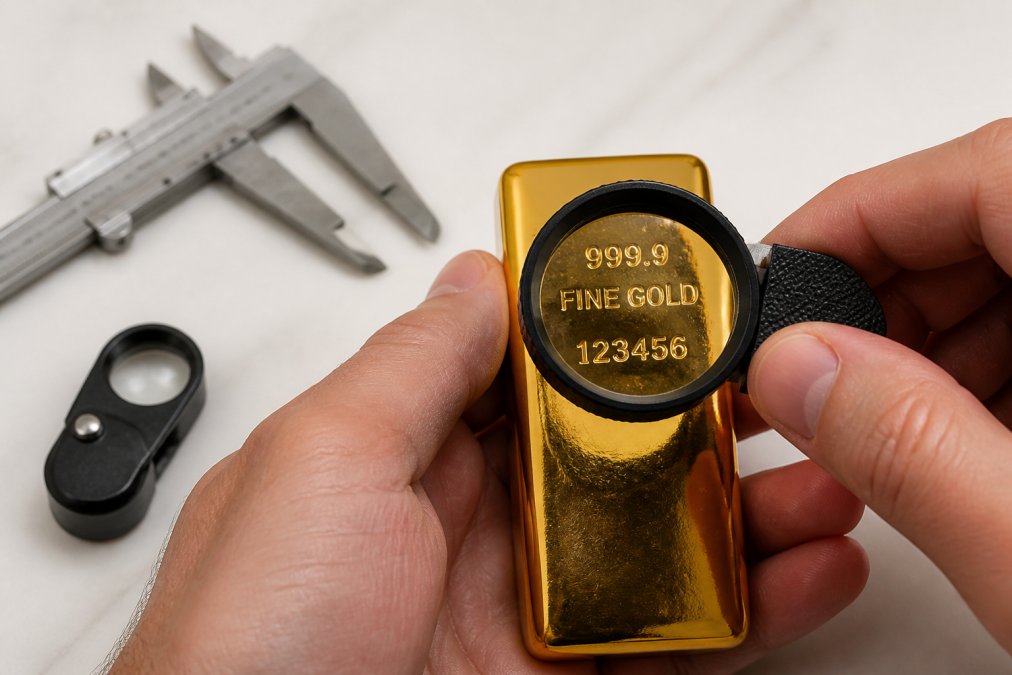
Visual inspection is the fastest first pass and the test most buyers skip. Every legitimate bar carries a hallmark: stamped marks identifying the refiner, purity, and often the year of manufacture.
Reading Purity Marks, Mint Marks, and Serial Numbers
A 1 oz gold bar should state its weight in troy ounces, its fineness, and a serial number matching the assay card. If the serials differ, stop. Fake bars often use wrong typography: a serif where the real mint uses sans-serif, or a logo with wrong proportions. Compare against the refiner's official reference images.
Checking Obverse and Reverse Details with a Loupe
The obverse (front) and reverse (back) of a struck bar carry fine detail casting cannot reproduce. Under a 10x loupe, genuine bars show sharp borders, smooth fields, and no porosity. But high-quality counterfeits now use actual stamping on a base-metal core, so visual inspection narrows the field without closing the case.
How to Perform a Gold Density Test at Home
The gold density test is the most reliable non-destructive check outside a lab. Gold has a specific gravity of 19.32, and a density calculation exposes bars with lighter cores. You need a 0.01 g scale, a container of water, and thin wire or thread; distilled water reduces error from dissolved minerals.
Specific Gravity Calculation Step by Step
- Weigh the bar dry. Record this as the dry weight.
- Suspend the bar by thread and weigh it fully submerged. Record this as the wet weight.
- Divide dry weight by (dry weight minus wet weight). The result is specific gravity.
- Compare to 19.32 for pure gold. A reading of 18.5 or lower signals a problem.
The catch: specific gravity confirms density, not composition. Tungsten's specific gravity of 19.25 is close enough that a tungsten-cored bar can pass. That's why density testing pairs with sound and dimension checks rather than replacing them.

Simple At-Home Tests: Magnet, Ping, and Ceramic Scratch
Three quick tests take under five minutes combined and catch most counterfeit bars. None is conclusive alone, but together they form a solid screening layer.
The Magnet Test and Diamagnetic Properties
Gold is non-magnetic but also diamagnetic, weakly repelling a magnetic field. A strong neodymium magnet slid down a tilted gold bar drags slightly rather than falling freely. A bar that sticks is not gold; zero resistance may mean gold or a non-magnetic fake like tungsten.
The Ping Test and Ringing Tone
Strike the bar with a fingernail or soft mallet. Genuine gold produces a long, high ringing tone that fades slowly; a dull thud suggests a base-metal core. Thick bars dampen sound, so the ping test works best on coins and thin bars.
The Ceramic Plate Scratch Test
Rub the bar's edge against an unglazed ceramic tile. Gold leaves a gold streak; pyrite and brass leave greenish or black marks. It only tests the surface layer, so a gold-plated tungsten bar passes cleanly.
Signs of Counterfeit Gold Bars: Packaging, Weight, and Dimensions
Packaging and physical measurements catch the fakes that pass every handheld test. Counterfeiters have invested heavily here in recent years, and most buyer guides stop short of covering it.
Counterfeit Packaging and Fake Assay Cards
A tamper-evident assay card is only as trustworthy as its source. Counterfeiters print convincing assay cards with matching serials, correct logos, and scannable barcodes leading to cloned verification pages. The card is one more item to inspect, not proof.
Work through the packaging in this order:
- Serial match. The serial stamped on the bar must match the card character for character. Watch easily confused glyphs: zero versus O, one versus I, five versus S. Counterfeiters exploit these substitutions because a glancing buyer reads them as identical.
- Print quality. Genuine cards use sharp microtext, consistent color registration, and card stock that flexes without cracking. Run a fingernail across the serial: genuine ink sits on the surface, while many fakes use a laser-printed overlay that feels raised or glossy against a matte background.
- Holograms and security foils. Tilt the card under light. A genuine hologram shifts through a defined color sequence and holds a crisp image at every angle; a photocopied or foil-stamped fake goes dull or muddy as the angle changes.
- QR and barcode destination. Scan the code, but check the address bar against the refiner's official domain. Cloned verification pages are a known tactic, often hosted on domains differing by a single character or a different top-level domain.
- Seal integrity. A tamper-evident card should show a continuous, unbroken seal. Look for a resealed edge, misaligned fold, or adhesive residue along the seam. A resealed card is not proof of a fake, but it removes the packaging from your evidence chain.
Weight Tolerance and Caliper Measurement
Every mint publishes exact dimensions and weight tolerance. Use a caliper and a 0.01 g scale: a 1 oz bar should weigh 31.103 g, and deviations beyond a few hundredths warrant suspicion. Measure thickness at three points and width at two; counterfeit bars are often slightly thick at the center to compensate for a lighter core. Record every measurement.

| Test | Time Needed | Catches | Misses |
|---|---|---|---|
| Visual and hallmark | 2-3 min | Crude fakes, wrong stamps | Plated tungsten |
| Magnet | 30 sec | Ferromagnetic cores | Tungsten, plated bars |
| Ping | 30 sec | Hollow or dull cores | Thick bars, plated fakes |
| Ceramic scratch | 1 min | Surface plating | Gold-plated cores |
| Density | 10-15 min | Wrong-density cores | Tungsten cores |
| Caliper and weight | 5 min | Dimensional shortcuts | Correctly sized fakes |
| Packaging and assay card | 3-5 min | Cloned cards, resealed packaging | High-quality replicas |
| XRF or ultrasonic | 5-10 min | Most counterfeits | Sealed multi-layer fakes |
Professional Verification Methods: XRF, Ultrasonic Testing, and Digital Authentication
When the stakes justify the cost, professional testing closes the gaps home methods leave open. A bullion dealer or assay lab can run these in minutes.
XRF Analyzers and Precious Metal Verifiers
An XRF analyzer (x-ray fluorescence) reads surface elemental composition without damaging the bar. A precious metal verifier using conductivity and resistivity offers similar surface-level confirmation at lower cost. Neither penetrates a thick bar, so a gold-plated tungsten core still reads as gold on XRF. Ultrasonic testing solves that by sending sound waves through the bar: tungsten and gold transmit sound at different speeds, so a cored bar produces a mismatched reading.
Digital and Blockchain Verification for Modern Bullion
A growing number of refiners issue bars with digital verification: a serial resolving to a blockchain record or manufacturer-hosted portal, where the refiner publishes the bar's weight, purity, and production batch. Check the serial directly at the source, not through a link printed on the packaging, since cloned verification pages are a known counterfeit tactic. Digital verification comes in three common forms, each with a different failure mode:
- Manufacturer-hosted portals. The refiner maps a serial to a product record. Strength: the refiner controls the data. Weakness: the portal is only as good as the refiner's security, and a cloned page can mimic the interface closely enough to fool a buyer who does not check the domain.
- Blockchain-anchored certificates. The refiner writes a record to a ledger, and the certificate carries a checkable hash. Strength: the record cannot be altered after the fact. Weakness: the chain proves the record exists, not that the bar in your hand is the one described. A counterfeiter can copy a real serial and hash onto a fake bar.
- QR-linked digital twins. A physical bar pairs with a digital record that updates as it changes hands. Strength: a documented chain of custody. Weakness: the chain is only as reliable as the parties who updated it.
Common Mistakes and Risks When Verifying Gold Bullion
Buy from sellers who provide matching serial numbers, original assay cards, and clear documentation of the refiner. At MMmetalsandmore, every bar ships with its assay certification intact and fully tracked, insured transit. Browse the PAMP Suisse 1 oz Silver Bar .999 Pure in Assay or the PAMP Suisse Zodiac 0.5g Fine Gold Bar in Certified Assay Card to see how matching serials and sealed assay packaging work in practice.

Frequently Asked Questions
How can I test if my gold is real at home?
Start with non-destructive checks: inspect the hallmark and serial number, weigh the bar against its stated mass, and measure its dimensions with a caliper. You can also perform a specific gravity test by weighing the bar in air and in water, then dividing the dry weight by the difference. A genuine gold bullion bar should match its stated weight tolerance closely. For conclusive results, visit a bullion dealer or use an XRF analyzer. Avoid acid tests on investment-grade bars because they damage the surface.
Does the magnet test work for verifying gold bullion?
The magnet test is a quick first check but not definitive. Gold is non-magnetic and diamagnetic, meaning a strong magnet will slide off a genuine bar with slight resistance. However, many counterfeit gold bars use tungsten or copper cores that are also non-magnetic, so passing the magnet test does not guarantee authenticity. Use it alongside a density test, ping test, and professional XRF analysis for reliable verification.
Why is checking the serial number important for gold bars?
A serial number links your bar to its assay card and the refiner's production records. On brands like PAMP Suisse, the serial number on the bar must match the number printed on the tamper-evident assay card exactly. If the numbers differ, or if the card shows signs of resealing, the bar may be counterfeit. You can often verify the serial number directly with the refiner or through the mint's online database.
What professional equipment is used to verify gold purity?
Bullion dealers and assayers use X-ray fluorescence (XRF) analyzers, which measure the elemental composition of the metal without damaging it. Ultrasonic testing detects internal voids or tungsten cores in bars. Some mints now offer digital or blockchain-based verification that ties a bar's serial number to a secure online record. For high-value purchases, ask the seller for an XRF readout or a certificate from a recognized assayer.
Verifying gold bullion is a skill, not a formality, and the fakes keep improving. MMmetalsandmore sources premium gold, silver, and copper bullion with original assay certification, matching serial numbers, and secure, insured shipping on every order. If you'd rather buy from a supplier that documents authenticity up front than gamble on an unverified bar, start with MMmetalsandmore and build your holdings on metal you can prove.