

Table of Contents
- Quick Comparison: Best Precious Metals for Beginners 2026
- Gold vs Silver for Beginners: Which Metal Fits Your Goals?
- 1. Silver Bullion: The Most Affordable Entry Point
- 2. Gold Bullion: Small Bars, Big Stability
- 3. Copper Bullion: The Industrial Metal for Patient Investors
- How to Buy Physical Gold in Canada: A Step-by-Step Guide
- Bullion Investment Tax Rules Canada: What Beginners Need to Know
- Common Mistakes Beginners Make With Precious Metals
- Frequently Asked Questions
Last Updated: September 20, 2026
Quick Comparison: Best Precious Metals for Beginners 2026
The best precious metals for beginners in 2026 are silver bullion for low-cost entry, fractional gold bars for stability, and copper rounds for patient industrial exposure. Silver starts near $92 for a one-ounce coin and a 1/200 oz gold bar runs $82, so either can be started for under $100.
Here is how the main options stack up:
| Metal | Entry Price | Best For | Main Trade-Off |
|---|---|---|---|
| Silver bullion | From $92.00 | First-time buyers, stacking | Bulkier to store |
| Gold bullion | From $82.00 | Wealth preservation | Tiny weights at low budgets |
| Copper bullion | Low per unit | Patient, long-horizon investors | Heavy, slower to liquidate |
Gold vs Silver for Beginners: Which Metal Fits Your Goals?
Silver wins on affordability and divisibility; gold wins on value density and stability. A 1 oz Canadian Silver Maple Leaf costs $100.83 and a 1/200 oz gold bar costs $82.00, so entry prices are closer than most people assume.

For beginners, the practical split looks like this:
- Start with silver if your budget is tight and you want to build the habit of buying metal regularly
- Start with gold if your goal is wealth preservation and you want a holding you can forget about for years
- Buy both if you can, because the two metals rarely move in perfect lockstep
1. Silver Bullion: The Most Affordable Entry Point
Silver bullion is the cheapest way to own physical metal and where most new stackers begin. A full troy ounce of .999 or .9999 fine silver runs around $92 to $106.
Top Silver Picks for New Investors
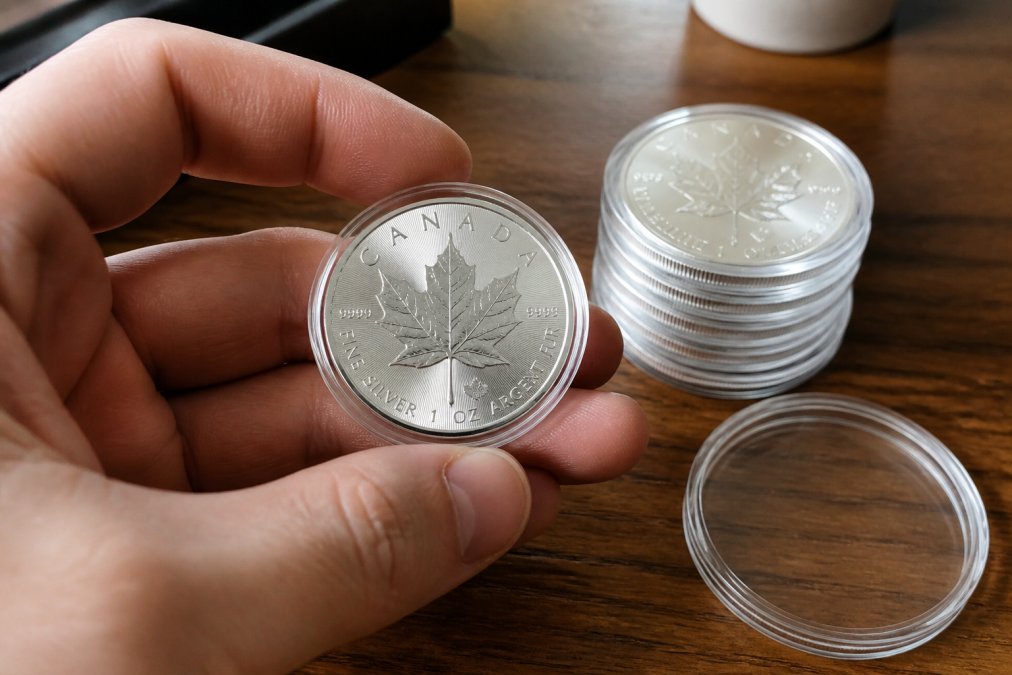
The 1 oz Canadian Silver Maple Leaf at $100.83 is the strongest first coin for most buyers, with a $5 CAD face value, four-nines purity, and a micro-engraved security mark backed by the Government of Canada, easy to recognize and easy to trade.
2. Gold Bullion: Small Bars, Big Stability
Gold bullion still delivers its wealth-preservation role, and you no longer need a large budget: fractional and gram-scale bars now make it accessible at prices that rival a single silver coin.
Fractional Gold Options Worth Considering
The Germania Mint 1/200 oz gold bar at $82.00 is the cheapest way onto the gold ladder, struck in 9999 pure gold and sealed in an assay card so weight and purity stay documented.
3. Copper Bullion: The Industrial Metal for Patient Investors
Copper bullion is the long-game option, trading at a fraction of silver's price per unit with demand tied to construction, wiring, and electronics rather than sentiment alone.
How to Buy Physical Gold in Canada: A Step-by-Step Guide
Buying physical gold takes about 30 minutes once you know the steps, but the details inside each step are where first-time buyers save money or lose it.
Step 1: Choose the right type of seller
There are three main channels, and each has a different cost and risk profile:
- Authorized bullion dealers (online or storefront), the standard route for beginners: live pricing, insured shipping, and invoices suitable for tax reporting.
- Banks and credit unions, convenient if you already bank there, but selection is limited to a few Mint products and premiums tend to be higher.
- Peer-to-peer marketplaces, lowest premiums, highest risk. Only suitable once you can verify authenticity yourself.
Step 2: Set a budget and a target weight
Decide what you can spend without touching emergency savings, then convert that budget into a target weight rather than a dollar amount, since premiums change daily. Aim for the largest single unit your budget allows, premium per gram falls sharply as unit size rises.
Step 3: Compare the real cost, not the sticker price
The number that matters is the premium over spot, the difference between spot price and what you pay. A 1 oz coin at a 4% premium is cheaper than a 1/10 oz coin at a 12% premium, even if the smaller coin has a lower total price.

Step 4: Confirm purity and certification
For gold, look for 9999 fine (24-karat) and a matching assay card or certificate carrying the refiner's name, weight, purity, and serial number. Their standardized packaging is widely recognized at resale.
Step 5: Pay and document
Keep the invoice to establish your adjusted cost base for capital gains reporting.
Step 6: Store it properly
Three realistic options for beginners:
- Home safe, lowest ongoing cost, but you carry the theft and fire risk.
- Bank safe deposit box, modest annual fee, limited access hours, contents not insured by the bank.
- Professional depository, segregated or allocated storage with insurance, typically billed as a percentage of value per year.
Match the choice to your holding size: a few ounces rarely justify a depository; a few thousand dollars usually do.
Step 7: Verify on arrival, the step beginners skip
This is where the authenticity gap bites. Before filing the piece away:
1 oz Canadian Silver Maple Leaf Coin →
- Weigh it on a scale accurate to 0.01 g and compare against the stated weight.
- Measure it with calipers against the refiner's published dimensions.
- Check the serial number on the bar against the number printed on the assay card.
- Inspect the seal, the assay card should be intact and tamper-evident.
- Magnet test, gold is not magnetic; a strong magnet should not attract the bar.
Bullion Investment Tax Rules Canada: What Beginners Need to Know
Tax treatment is where beginner guides get vague, and vagueness is expensive. Here is how the rules apply to the metals a beginner is likely to buy.
GST/HST: the purity threshold is the whole game
Investment-grade bullion is exempt from GST/HST when it meets federal purity thresholds. In practice:
- Gold must be 99.5% pure or higher, which covers virtually every modern bullion bar and coin, including 9999 fine products.
- Silver must be 99.9% pure or higher, which covers .999 and .9999 coins and bars, but not sterling silver (92.5%) or junk silver.
- Platinum must be 99.9% pure or higher.
Capital gains: what you actually owe
When you sell bullion for more than you paid, the gain is a capital gain and must be reported on your annual return. The taxable portion is set by the federal inclusion rate, which the Canada Revenue Agency publishes and updates, confirm the current rate there rather than relying on secondhand advice.
Two mechanics matter for beginners:
- Adjusted cost base (ACB), your purchase price plus any fees directly tied to the acquisition. Every invoice you keep feeds into this number.
- Reporting form, capital gains are reported on the schedule the CRA designates for that tax year. Your accountant or tax software will map the ACB and proceeds to the correct line.
Canada Revenue Agency guidance on reporting capital gains
Record-keeping: the part that saves you money
Without a purchase record, you cannot prove your adjusted cost base and may pay tax on more gain than you made. Keep, for every purchase:
- The dealer invoice showing date, quantity, metal, purity, and price paid
- The assay card or certificate, if the product came with one
- Shipping and insurance receipts, if they were charged separately
- A simple spreadsheet tracking date, unit, price, and running ACB
Registered accounts and the IRA question
Confirm your situation with an accountant, since rules differ depending on whether the metal is held directly, through a trust, or through a fund.
Royal Canadian Mint information on bullion coin specifications
Fractional and micro-purchases: the tax angle nobody mentions
Micro-investing, buying 1/10 oz coins or gram-scale bars on a schedule, carries a tax consequence large-bar buyers avoid: more transactions means more ACB tracking. Each purchase is a separate cost base, and each sale must be matched against the right purchase. That is not a reason to avoid fractional buying, but it is a reason to keep disciplined records from the first purchase.

Common Mistakes Beginners Make With Precious Metals
The most common mistake is buying on emotion after a price spike, chasing a rally usually means paying the year's highest premium.
Here are the others we see most often:
- Ignoring the premium. The spread between spot price and what you pay is your real cost. Compare it before you compare designs.
- Skipping authentication. Buy from sellers who provide assay cards and serial numbers, then verify them.
- Overweighting one metal. Putting everything into silver or everything into gold adds risk you did not need to take.
- Forgetting storage costs. A safe, a box, or a depository all carry fees. Factor them into your return.
- Confusing numismatic value with bullion value. A rare coin and a bullion coin are different asset classes with different liquidity.
OECD guidance on responsible mineral supply chains
Frequently Asked Questions
What is the best precious metal to invest in for beginners in 2026?
Silver is often the most accessible starting point because of its lower entry price. A 1 oz Canadian Silver Maple Leaf Coin costs $100.83, while a 1/10 oz St. Helena Rose Spade Guinea Shield round is just $15.48. Gold offers stability, with small bars like the Germania Mint 1/200 oz at $82.00. Copper provides an industrial hedge. Many beginners start with silver, then add gold as their budget allows.
Is it better to buy silver or gold as a beginner?
It depends on your budget and goals. Silver is cheaper per ounce and easier to accumulate in small amounts, making it ideal for learning how physical metals work. Gold holds more value per gram and tends to be less volatile, which suits long-term wealth preservation. A common approach is to build a silver core first, then add fractional gold bars like the PAMP Suisse 0.5g Zodiac bar at $170.00 when ready.
What are the tax implications of buying precious metals in Canada?
In Canada, investment-grade bullion (99.5% purity for gold, 99.9% for silver) is exempt from GST/HST. This applies to products like the 1 oz Canadian Silver Maple Leaf and the PAMP Suisse 1 oz Silver Bar. Capital gains tax applies when you sell at a profit, with 50% of the gain added to your taxable income. Keep detailed records of purchase dates and prices for accurate reporting.
How do I start investing in physical bullion in Canada?
Start by setting a budget and choosing a metal. For beginners, silver rounds like the 1 oz Silver Buffalo Round at $100.69 offer low premiums and high liquidity. Buy from a reputable dealer that provides secure shipping and assay certificates. Store your metals in a safe or safety deposit box, and consider starting with fractional pieces to keep costs manageable. Always verify authenticity using the security features on your coins or bars.
Are there risks associated with holding physical precious metals?
Yes. Storage risk, theft, and market volatility are real concerns. Spot prices fluctuate daily, so short-term losses are possible. Physical metals also carry dealer premiums and potential storage fees. To manage risk, diversify across metals, buy from trusted sources with secure delivery, and store your holdings in a secure location. Start with smaller, liquid pieces like 1 oz silver coins before committing larger amounts.