

Table of Contents
- 1. Match Rare Gold Coins to Your Collecting Goals
- 2. Buying From Reputable Coin Dealers and Trusted Sellers
- 3. How to Authenticate Gold Coins Before You Buy
- 4. How to Grade Collectible Coins Accurately
- 5. Understanding Rare Gold Coin Value: Melt, Premium, and Demand
- 6. How to Store Collectible Coins Safely
- 7. Buyer Protections, Returns, and Resale Planning
- Conclusion: Buying Rare Gold Coins With Confidence
- Frequently Asked Questions
Last Updated: October 8, 2026
1. Match Rare Gold Coins to Your Collecting Goals
Tips for buying rare gold coins start with one question most buyers skip: why are you buying? At MMmetalsandmore, we see two very different buyers walk through the same door. One wants gold as a store of value. The other wants a piece with a story, a low mintage, and a design worth showing.
Rare gold coins sit in a different category from plain bullion. A bullion round tracks the gold price. A rare coin carries numismatic value on top of its metal content, and that premium can swing far more than spot does.
Before you spend, write down your goal:
- Investment-first: You care about gold content, purity, and resale liquidity.
- Collection-first: You care about rarity, design, and historical significance.
- Gift or entry point: You want certified gold in a small, displayable format.
Our ICG MS70 Eagle Head 1/500th oz Fractional Gold Round suits the collector who wants certified gold without a full-size budget. It arrives sealed in a tamper-evident ICG slab, graded MS70.

2. Buying From Reputable Coin Dealers and Trusted Sellers
Dealer reputation decides more of your outcome than any single coin. A trusted seller stands behind authenticity, grading, and delivery. A weak one disappears after the sale.
Ask any coin dealer three questions before money changes hands:
- Do you provide written documentation of authenticity and grade?
- What is your return window, and who pays return shipping?
- How is the package insured in transit?
A dealer's expertise shows in how they answer, not in how they market. Sellers who grade and authenticate in-house should explain their process in plain terms.
The Canadian Numismatic Association publishes collector resources and dealer standards worth reviewing before you commit to a seller.
3. How to Authenticate Gold Coins Before You Buy
Authenticating gold coins means confirming three things: real gold, correct weight, and a genuine strike. Skip any one and you may pay numismatic money for a fake.
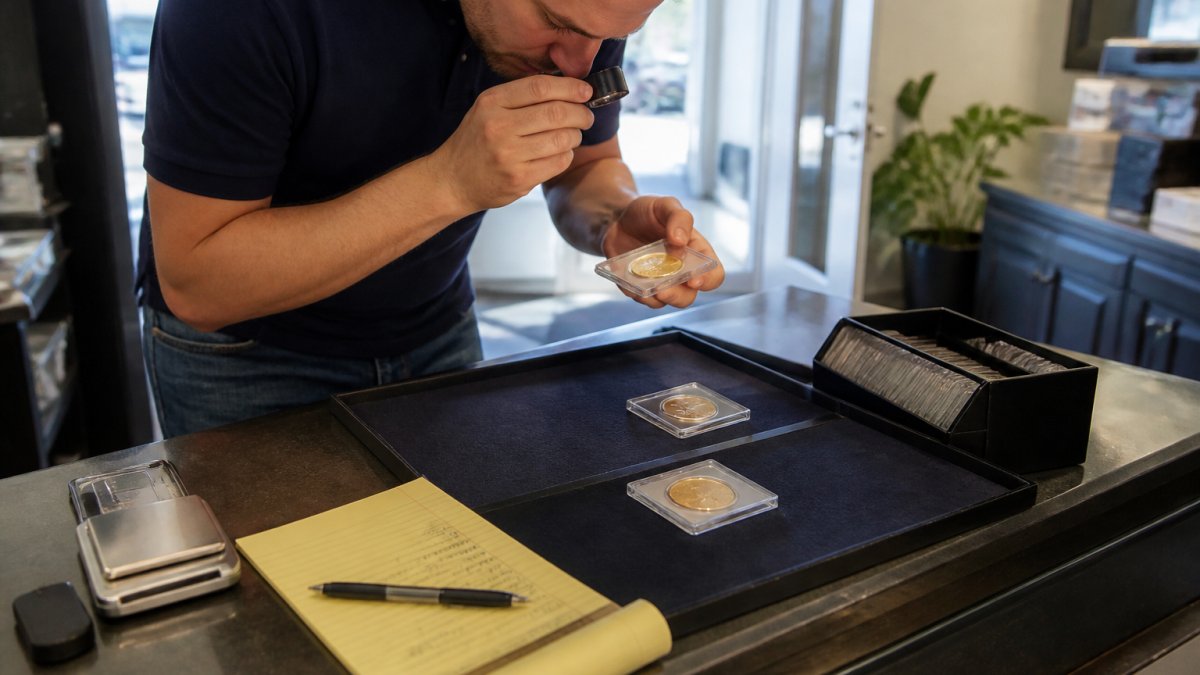
Start with weight and diameter. Mints publish exact specifications, and a counterfeit usually misses them. A calibrated scale and a set of calipers catch most problems in under a minute.
Then check the strike itself. Genuine coins show sharp relief, clean edges, and consistent lettering. Fakes look soft, grainy, or slightly off-center.
Counterfeit and Altered Gold Coin Warning Signs
- Magnetic response: Pure gold is not magnetic. A coin that sticks to a magnet is wrong.
- Wrong weight or diameter: Even a small deviation matters.
- Mushy details: Soft lettering or blurred relief points to a cast copy.
- Tooling marks: Altered coins often show file marks or added mintmarks.
- Missing paperwork: A slab with no verifiable certification number is a red flag.
4. How to Grade Collectible Coins Accurately
Grading collectible coins accurately means judging surface, strike, luster, and wear against a published scale. The Sheldon 1-70 scale is the standard dealers and graders use.

Learn the four factors:
- Surface: Marks, hairlines, and contact damage
- Strike: How fully the design was pressed
- Luster: The original mint bloom, or its absence
- Wear: Flattening on the high points of the design
A coin graded MS70 shows no post-production imperfections under magnification. Lower grades show progressively more wear or marks.
Verifying Third-Party Grading and Certification
Third-party grading removes the guesswork, but only if you verify it. Every major grading company assigns a unique certification number.
Look up that number on the grader's own website. Confirm the coin's date, denomination, and grade match the physical piece in front of you. If the number does not exist, or the details differ, walk away.
5. Understanding Rare Gold Coin Value: Melt, Premium, and Demand
Rare gold coin value breaks into two parts: melt value and numismatic premium. Melt value is the gold content at the current spot price. Premium is everything the market adds on top.
For a small fractional piece, melt value is modest. The premium reflects rarity, condition, and collector demand. That is why two coins with identical gold content can sell at very different prices.
| Value Component | What It Reflects | What Moves It |
|---|---|---|
| Melt value | Gold content at spot price | Daily metal markets |
| Purity premium | Fineness, such as .999 or .9999 | Refining and certification |
| Numismatic premium | Rarity, grade, demand | Mintage, condition, collector interest |
| Liquidity discount | How fast a dealer will buy | Popularity of the series |
A limited mintage tightens supply. The Rainbow Unicorn 1/1000 oz .999 Fine Gold Shaped Coin caps at 5,000 pieces worldwide, and shaped coins like this tend to hold collector attention.
ICG MS70 Eagle Head 1/500th oz Fractional Gold Round Slabbed →

Researching Prices With Comparable Sales
Comparable sales are the most reliable price guide. Find recent sales of the same coin in the same grade, then average them.
Check auction results, dealer listings, and certified coin databases. Ignore asking prices that never sold. A coin listed high for a year tells you nothing about its real market value.
6. How to Store Collectible Coins Safely
Storing collectible coins safely means controlling moisture, temperature, and handling. Gold does not rust, but the wrong environment still damages value.
Keep coins in a cool, dry place away from temperature extremes. Avoid attics, basements, and anywhere humidity swings.
Use the right holder:
- Slabs: Keep certified coins sealed. Breaking a slab destroys the certification.
- Capsules: Use inert plastic for raw coins.
- Assay cards: Leave coins in their original card.
Skip PVC holders entirely. PVC breaks down over time and leaves a green residue that permanently damages a coin's surface.
7. Buyer Protections, Returns, and Resale Planning
Buyer protections and resale planning belong in the same conversation, because both depend on documentation. Keep every invoice, certification number, and grading record.
Before you buy, confirm:
- The return window and who covers return shipping
- How the seller insures shipments in transit
- Whether the coin ships with a certificate of authenticity
- What records you will need at resale
On the exit side, know your buyer. Dealers buy quickly at a wholesale price. Auction platforms can reach higher prices but charge seller fees and take time.
Plan for the spread. The difference between what you pay and what a dealer pays you is your real cost of ownership. Coins with strong collector demand and clear certification narrow that spread.
Our 2026 Liberia Casino High Roller 1/1000 oz .9999 Pure Gold Coin ships sealed in an assay card with the Certificate of Authenticity built in, which keeps the paperwork you will need later in one place.
Conclusion: Buying Rare Gold Coins With Confidence
The hard part of buying rare gold coins is not finding them. It is separating a genuine, well-graded piece from an overpriced one. Confirm authenticity, verify the certification, and price against real sales before you commit.
At MMmetalsandmore, we stock premium gold, silver, and copper bullion alongside a wide selection of collectible coins, all shipped securely with professional service. Our fractional gold pieces arrive certified and ready to store, which takes the guesswork out of your first purchase.
Get started with MMmetalsandmore and add certified gold to your collection with confidence.
Frequently Asked Questions
What should I check before buying a rare gold coin?
Start with four things: the coin's certification and grade, the dealer's reputation, the premium over melt value, and the return policy. Verify the coin's gold content and purity, look for tamper-evident packaging, and confirm the seller provides documentation. For fractional pieces, MMmetalsandmore lists options like the ICG MS70 Eagle Head 1/500th oz Fractional Gold Round at $57.07 and the Liberia Casino High Roller 1/1000 oz coin at $39.00, both graded or sealed with assay documentation. Match each purchase to your collecting goals before you commit.
How can I tell whether a rare gold coin is authentic?
Weigh and measure the coin against published specifications for that issue, check the strike quality and edge details under magnification, and compare the design against reference images. Look for soft or mushy details, wrong fonts, or seams that suggest casting rather than striking. If the coin is certified, verify the slab's serial number with the grading company. Buying from a dealer who provides assay cards or third-party certification, and who stands behind the sale, removes most of the guesswork from authentication.
How does coin grading affect a rare gold coin's value?
Grade drives value because it quantifies condition, and condition determines how much of a premium a collector will pay above melt. A coin graded MS70 shows no post-production imperfections under magnification, while lower grades show wear, marks, or surface issues that reduce demand. For modern issues, the jump between grades can be significant because high-grade populations are tracked. Certification from a recognized grading service also makes resale easier because buyers trust the label. Always factor grading fees and certification into what you pay.
Should I buy graded or ungraded rare gold coins?
Graded coins cost more but come with verified condition and easier resale, which suits buyers who want certainty. Ungraded coins can offer better value if you can assess condition yourself or work with a dealer you trust. For beginners, certified pieces remove the risk of overpaying for a coin that does not match its described grade. MMmetalsandmore offers examples at both ends, from the ICG MS70 Eagle Head round at $57.07 to the Solomon Islands Remembrance Day coin at $68.00, so you can start where your comfort level sits.
What should I avoid storing coins in?
Avoid PVC holders, which release plasticizers over time and leave a green residue that damages surfaces. Skip paper envelopes and cardboard flips that are not acid-free, and never store coins loose in a drawer where they can scratch each other. Keep coins away from moisture, temperature extremes, and direct sunlight. Use inert capsules, archival slabs, or the sealed assay cards that coins like the Rainbow Unicorn 1/1000 oz piece arrive in. A cool, dry safe or display case with stable conditions protects both metal and numismatic value.