

Table of Contents
- How Secure Delivery for Precious Metal Orders Works
- Precious Metal Shipping Insurance and Liability Coverage
- Precious Metal Delivery Signature Requirements and Verification
- Discreet Packaging for Bullion: What to Expect
-
Step-by-Step: How to Receive a Bullion Delivery Safely
- What You'll Need
- Step 1: Verify the Tracking Number Before Opening [Time: 1 minute]
- Step 2: Inspect the Seal and Box Condition [Time: 2 minutes]
- Step 3: Sign Only After Inspection [Time: 1 minute]
- Step 4: Open and Verify Contents [Time: 3 minutes]
- Step 5: Store and File Documentation [Time: 2 minutes]
- Tracking, Tamper-Evident Seals, and Post-Delivery Security
- Conclusion
- Frequently Asked Questions
Last Updated: September 26, 2026
How Secure Delivery for Precious Metal Orders Works
Secure delivery for precious metal orders is the chain of custody, verification, and insurance controls that move bullion from a seller's vault to your hands without loss, substitution, or tampering. At MMmetalsandmore, every order ships under a documented custody trail.
Chain of Custody From Vault to Doorstep
A chain of custody is the unbroken record of who controlled an asset between dispatch and delivery. Break it, and liability disputes become your problem.
Precious Metal Shipping Insurance and Liability Coverage
Precious metal shipping insurance is third-party or carrier-provided coverage that pays out if a shipment is lost, stolen, or damaged in transit, not the carrier's standard liability limit.
What Happens When a Package Goes Missing
Report it immediately, in writing, and keep the packaging. The paper trail you build in the first 48 hours usually decides the outcome.
Most claims processes follow the same sequence:
- File a missing-package report with the carrier and get a case number
- Notify the seller in writing the same day
- Retain the original box, seal, and any enclosed paperwork
- Cooperate with the carrier's investigation and provide the case number
- Wait for the outcome, which may include a replacement or a refund
Documentation That Decides Claims
A claim is only as strong as the record behind it. The documents that matter:
- The dispatch email showing the tracking number and declared value
- The scan history from pickup through final delivery attempt
- Photographs of the package on arrival, including all four sides and the seal
- The signed proof of delivery, if one exists
- The police report number, for theft
- The assay card or serial record, to prove what was in the box
Precious Metal Delivery Signature Requirements and Verification
Precious metal delivery signature requirements mean the courier cannot release the parcel without an adult signature at the destination address, the single most important control in the process.
| Verification Step | What It Confirms | If Skipped |
|---|---|---|
| Adult signature | Right person, right time | Claim may be denied |
| Photo ID match | Identity of recipient | Release to wrong party |
| Address confirmation | Correct destination | Misdelivery disputes |
| Scan at door | Delivery timestamp | Longer investigations |
Discreet Packaging for Bullion: What to Expect
Discreet packaging for bullion means the outer box carries no branding, no metal content description, and no visible value declaration. A passerby should not be able to tell a silver bar from a paperback.

What you should expect:
- Plain, unbranded corrugate with no logo or product name
- A tamper-evident seal that shows visible damage if opened
- Inner protective packaging that keeps the item from shifting
- Shipping documentation that does not advertise contents
- A tracking number issued at dispatch
Step-by-Step: How to Receive a Bullion Delivery Safely
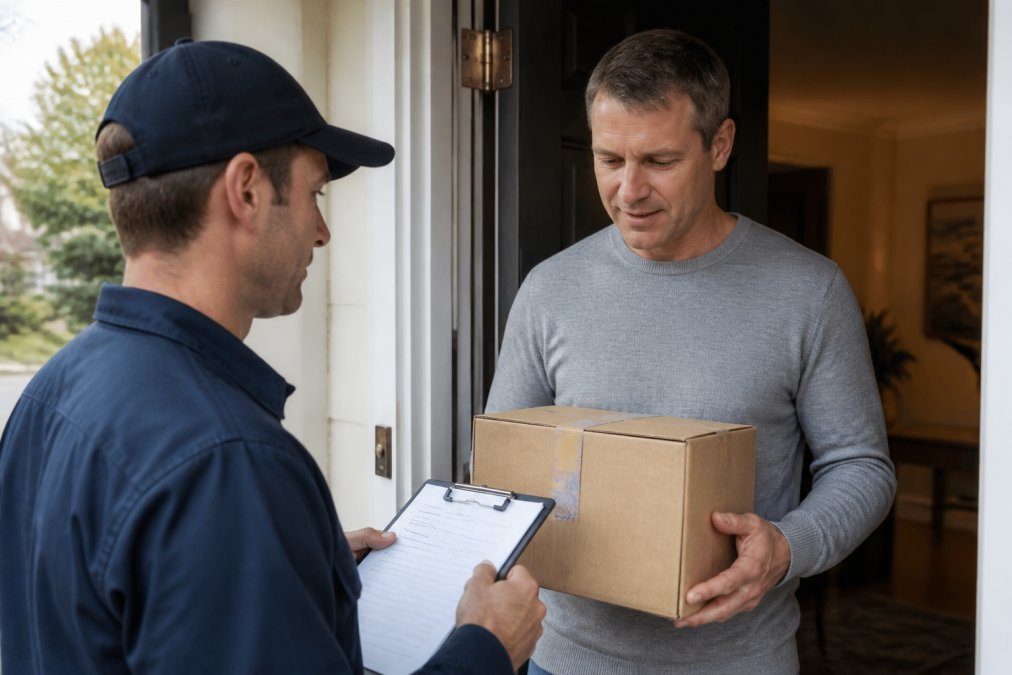
Receiving a bullion delivery safely is a five-minute routine, and skipping any step is how people end up in disputes they can't win.
Total Time: 5-10 minutes Difficulty: Beginner
What You'll Need
- Government-issued photo identification
- Your tracking number
- A phone or camera for photographs
Step 1: Verify the Tracking Number Before Opening [Time: 1 minute]
Match the tracking number on the label to the one in your dispatch email. A mismatch means the parcel is not yours.
Expected Result: Confirmed matching tracking numbers.
Step 2: Inspect the Seal and Box Condition [Time: 2 minutes]
Check the tamper-evident seal for cuts, resealing, or lifting. Photograph all four sides of the box before you open it.
Expected Result: A dated photo record of the package as received.
PAMP Suisse 1 oz Silver Bar .999 Pure →
Step 3: Sign Only After Inspection [Time: 1 minute]
Sign for the parcel only once you've confirmed the seal is intact. Ask the courier to scan the package at your door.
Expected Result: A scan event timestamped to your address.
Step 4: Open and Verify Contents [Time: 3 minutes]
Open the package and confirm the item, serial number, and assay documentation match your order. Check that the assay card is sealed and the serial matches the bar.
Expected Result: Contents verified against your order confirmation.
Step 5: Store and File Documentation [Time: 2 minutes]
Move the item to your storage location and file the tracking record, photographs, and assay card together.
Expected Result: A complete record set for insurance or resale purposes.
Tracking, Tamper-Evident Seals, and Post-Delivery Security
Post-delivery security is where most buyers relax, and it's exactly where the risk shifts. The courier's job ends at your door. Yours begins there.
How Tamper-Evident Packaging Actually Works
Tamper-evident packaging (TEP) is a layered system, not a single sticker. Understanding the layers tells you what to inspect.
- Void-indicating tape or labels. These leave a residue pattern, often the word 'VOID' or a checkerboard, if peeled and reapplied. The residue is the evidence, not the tape itself.
- Shrink bands and security seals. Common on assay packaging, these are designed to tear or discolor on opening. A seal that looks stretched or cloudy has likely been manipulated.
- Serialized closure labels. Some packers apply a numbered label across the box seam. If the number on the label doesn't match the dispatch record, the package has been opened.
- Inner retention packaging. Foam inserts and molded trays prevent shifting, but they also make it harder to remove and replace an item without disturbing the arrangement. A bar that sits loosely in a tray that should hold it snugly is a warning sign.
Receiving Protocol: The First Ten Minutes
The doorstep is the last point where the chain of custody is still visible to you. Treat it as an inspection, not a handoff.
- Confirm the tracking number on the label matches your dispatch email.
- Photograph all four sides of the box and the seal before signing.
- Sign only after the seal is confirmed intact, and ask the courier to scan at your door.
- Open the package in a controlled space, not on a porch or in a lobby.
- Verify the item, serial number, and assay documentation against your order.
- Photograph the contents before removing them from the inner packaging.
- Move the item to its storage location the same day.
Storage Trade-Offs After Delivery
A home safe is the default answer, and often the wrong one. The trade-offs:
- Home safe. Convenient and private, but portable models can be removed whole, and a safe that is known to contain bullion is a target rather than a deterrent. Bolting it down and keeping its contents undisclosed improves the picture.
- Safety deposit box. Strong physical security and institutional custody, but limited access hours and no insurance unless you arrange it separately. Contents are not automatically covered by the institution.
- Third-party vault. Purpose-built for bullion, with segregated storage and audit trails, but ongoing fees and a counterparty you must vet. Ask about insurance, segregation, and how withdrawals work before committing.
- Distributed storage. Splitting holdings across locations reduces single-point loss. The cost is administrative, more records, more places to track.
Post-Delivery Habits That Matter
Three habits do most of the work. Don't post about your purchase on social media. Don't leave packaging curbside where it advertises what arrived. And don't store everything in one place.
Conclusion
The gap between a routine bullion purchase and a costly dispute usually comes down to delivery discipline, not luck. Choose a seller who ships fully insured with signature-required, tamper-evident packaging, then hold up your end at the door.
Frequently Asked Questions
Is shipping insurance mandatory for precious metal orders?
Most reputable dealers include full insurance on every bullion shipment, but it may appear as a separate line item at checkout. Ask before you buy. Insurance should cover the full replacement value of your order from the moment it leaves the vault until you sign for it. Third-party insurance is sometimes used alongside the courier's own coverage. If a dealer does not offer insurance, that is a red flag. Confirm the coverage amount matches your invoice total before completing your purchase.
How does signature-required delivery protect bullion buyers?
Signature-required delivery means the courier cannot leave your package at the door or with a neighbor. You or an authorized person must sign in person, and the carrier records the name and time. This creates proof of delivery and prevents porch theft. Some dealers add delivery authorization steps, such as requiring photo ID or a one-time code, for orders above a certain value. If you miss the delivery window, the package typically returns to a depot for pickup rather than sitting unattended.
What should I do if my precious metal package arrives damaged or tampered with?
Do not open the package further. Photograph the box, the tamper-evident seal, and any visible damage before touching the contents. Contact the dealer immediately with your tracking number and photos. Most insurers require a claim within 24 to 48 hours of delivery. Keep the original packaging, because the claims process may require it as evidence. If the seal is broken but the contents appear intact, still report it. A compromised seal can void the assay certification on sealed bars.
How do reputable dealers ensure discreet packaging for bullion shipments?
Discreet packaging means the outer box carries no branding, no mention of precious metals, and no value indicators. The return address uses a generic company name or initials. Inside, bullion sits in tamper-evident assay cards or sealed capsules, often wrapped in padding that prevents movement. The tracking number does not reveal contents. Some dealers also vary box sizes and shipping days so patterns are harder to spot. If a package arrives with visible branding or rattling contents, document it and report it to the dealer.