

Table of Contents
- Why Rare Numismatic Coins for Sale Online Beat Local Dealer Inventory
- How Are Rare Coins Graded Professionally?
- Rare Canadian Coins Value Guide: What Drives Price
- Certified Numismatic Coins Online: How to Verify Before You Buy
- Graded and Slabbed Silver Dollars Worth Adding in 2026
- Gold and Silver Bullion vs Numismatic Rarities: Which Fits Your Portfolio
- Tax and Authentication Rules Canadian Collectors Should Know
- Frequently Asked Questions
Last Updated: September 27, 2026
Why Rare Numismatic Coins for Sale Online Beat Local Dealer Inventory
The gap between what a local coin shop can stock and what exists in the wider market is enormous, and that gap is exactly why buying rare numismatic coins for sale online has become the default for serious collectors. A single dealer might hold a few hundred pieces; the online market spans thousands of certified specimens from mints around the world.
How Are Rare Coins Graded Professionally?
Professional grading is a standardized, multi-step inspection in which trained numismatists examine a coin's strike, surface, luster, and eye appeal, then assign it a numeric grade on the 70-point Sheldon Scale and seal it in a tamper-resistant holder.
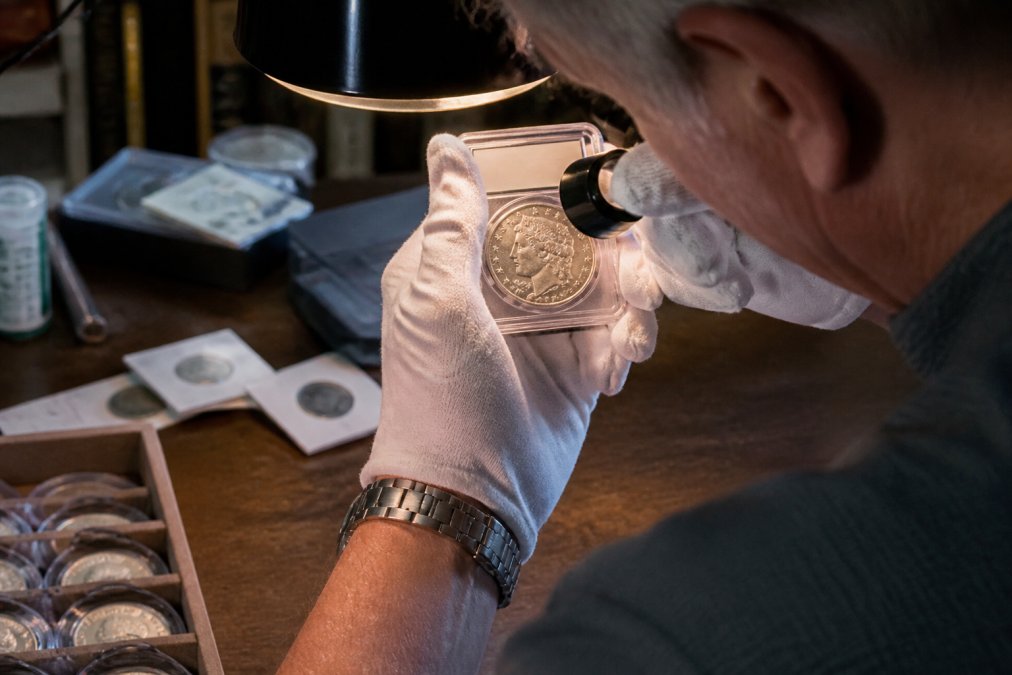
PCGS vs NGC: What the Slab Actually Tells You
Two grading services dominate the certified coin market: PCGS and NGC. Both authenticate a coin, assign its grade, and encapsulate it with a label showing the grade and a unique certification number you can verify online. A "slabbed" coin is simply one that has passed through this process and now sits in a sealed holder.
Mint State, Proof, and the Sheldon Scale Explained
Mint State describes an uncirculated coin, graded from MS60 to MS70, with MS70 meaning flawless under magnification. Proof refers to a coin struck with polished dies and specially prepared blanks, producing mirror-like fields and frosted raised details. The Sheldon Scale is the 1-to-70 numbering system both major graders use.
| Grade | Label | What It Means |
|---|---|---|
| MS60-62 | Uncirculated | No wear, but bag marks and weak strike common |
| MS63-65 | Choice Uncirculated | Strong detail, original luster, minor marks |
| MS66-69 | Gem Uncirculated | Few marks, sharp strike, full luster |
| MS70 | Perfect Uncirculated | Flawless under 5x magnification |
Rare Canadian Coins Value Guide: What Drives Price
Four factors decide what a rare Canadian coin is worth: rarity, grade, provenance, and current collector demand. A low mintage figure alone doesn't guarantee value if few collectors want the piece.
Royal Canadian Mint Commemoratives and Their Collector Value
Royal Canadian Mint commemorative dollars from the 1980s remain among the most accessible entry points for new collectors. The 1982 Regina Centennial dollar, struck in 50% fine silver with a frosted proof finish and a bison skull reverse by Huntley Brown, arrives in its original clamshell case. Our listing is $81.69.

Certified Numismatic Coins Online: How to Verify Before You Buy
Verification is the step that separates a confident purchase from a hopeful one, and it takes about two minutes per coin. Every certified numismatic coin online should come with a certification number you can check directly against the grader's public registry.
The Three Checks That Matter Most
- Confirm the cert number exists and matches the grade printed on the label
- Compare the registry photo against the coin shown in the listing
- Confirm the seller's return policy in writing before payment
If any of those three fails, walk away. A legitimate seller will hand over the cert number without hesitation; a vague answer is your cue to stop.
Raw vs. Slabbed: Why the Holder Is the Real Product
Most buying guides skip the distinction that matters most to a first-time buyer: a raw coin is loose, ungraded, and priced on the seller's opinion, while a slabbed coin has been authenticated, graded, and sealed by a third party. The slab is not packaging, it is a chain of custody. The certification number ties that exact coin to a grading record, and that record is what a future buyer will pay against.
Vetting the Seller, Not Just the Coin
Grading protects you from a misdescribed coin. It does nothing about a seller who ships late, substitutes a different piece, or disappears after payment. Before a high-value purchase, check for:
- A written return window long enough to inspect the coin in hand
- A payment method that offers a dispute process rather than a direct transfer
- A physical business address and a reachable contact, not just a web form
- Consistent, high-resolution photos of the actual coin, not stock images
Competition Bureau guidance on online shopping rights
What to Keep After the Sale
Save the invoice, the cert number, and the listing photos. Documentation is what protects you at resale, and it is the first thing a serious buyer asks for.
Graded and Slabbed Silver Dollars Worth Adding in 2026
Two graded US silver dollars stand out for collectors building a certified set this year. The 1923 Peace Silver Dollar, graded PCGS MS63 with certification number 37089870, shows uncirculated detail with original mint luster and measures about 38.1 mm across. It's listed at $110.45.

Gold and Silver Bullion vs Numismatic Rarities: Which Fits Your Portfolio
Bullion and numismatic coins do different jobs, and mixing them up is the most expensive mistake new buyers make. Bullion tracks the spot price of gold or silver. Numismatic rarities trade on collector demand, which can move independently of metal prices. Neither is "better", they solve different problems.
| Factor | Bullion | Numismatic Rarities |
|---|---|---|
| Price driver | Spot metal price | Rarity, grade, demand |
| Liquidity | High, easy to sell | Varies by coin and market |
| Premium over metal | Lower | Often much higher |
| Best for | Metal exposure | Collector value and rarity |
A Beginner's Framework for Splitting the Two
Most practitioners find that the split matters less than the order you buy in. A practical sequence for a new collector:
- Start with bullion for the core. It is liquid, its pricing is transparent, and it gives you a baseline for reading premiums before you touch anything graded.
- Add graded rarities with money you will not need to liquidate quickly. Numismatic coins can sit on the market for weeks or months, and a forced sale usually means a discount.
- Buy the grade, not the story. A common date in a high grade is often a better entry than a rare date in a low grade, because the high-grade piece has a deeper pool of buyers.
- Keep the two buckets separate in your records. Bullion is priced against spot; rarities are priced against comparables. Mixing them makes it hard to tell whether you actually made money.
The Trade-Off Nobody Explains
Bullion gives you liquidity and a known reference price. Rarities give you upside that is uncorrelated with metal prices, but only if you can hold. The mistake is buying a rarity with money earmarked for something else, then selling into a thin market at a loss. If you cannot name the holding period before you buy, the coin is probably the wrong one.
Where the Two Overlap
Some pieces sit in both worlds, for example, a low-mintage bullion release with a strong collector following. These can be a reasonable bridge for a new buyer, but they carry both a metal premium and a collector premium, so the entry price is higher and the resale market is narrower. Treat them as rarities, not as bullion, when you size the position.
Tax and Authentication Rules Canadian Collectors Should Know
Canadian tax treatment differs depending on what you buy. Investment-grade fine bullion is generally exempt from GST/HST, while numismatic coins with collector premiums typically are not. Because rules and thresholds change, confirm current treatment with the Canada Revenue Agency before a large purchase.
Frequently Asked Questions
How are rare coins graded professionally?
Professional grading happens at third-party services like PCGS and NGC. A grader examines the coin under magnification, scores surface preservation, strike quality, luster, and eye appeal, then assigns a Sheldon scale number from 1 to 70. The coin is then sealed in a tamper-resistant slab with a certification number you can verify in the grader's online registry. That slab is what separates a certified numismatic coin from an unverified raw one.
How can I verify the authenticity of rare numismatic coins bought online?
Start with the certification number on the slab. Both PCGS and NGC maintain public verification registries where you can confirm the grade, date, and mint match the physical coin. Check that the holder shows no signs of tampering, and compare the coin's weight and diameter against published specs.
Which Canadian coins hold the most numismatic value?
Low-mintage Royal Canadian Mint issues drive most of the value. Key dates, error coins, and early proof commemoratives tend to hold collector value best. The 1982 Regina Centennial, 1986 Vancouver Centennial, and 1987 Davis Strait proof dollars are examples of vintage RCM releases with steady collector demand because of their 50% fine silver content and limited production. Condition matters as much as rarity: a proof finish with original packaging commands more than a circulated example.
What factors determine the market value of rare numismatic coins?
Four things move price: rarity (mintage and surviving population), grade (certified condition on the Sheldon scale), provenance (who owned it and whether that history is documented), and market liquidity (how easily it resells). Silver content sets a floor for bullion-backed pieces, but collector value sits above that floor. A PCGS MS63 Peace Dollar and an NGC MS70 Morgan illustrate how the grade alone can shift price significantly.
Are GST or HST charged on numismatic coins in Canada?
Investment-grade fine bullion, defined as coins or rounds that are 99.9% or higher pure silver or gold, is generally exempt from GST and HST in Canada. Numismatic coins that fall below that purity threshold, such as 50% fine silver proof dollars, may be taxable. Check the product listing for the tax status, and confirm current CRA guidance before you file, since rules can change.
The hardest part of collecting isn't finding rare coins, it's finding a seller who documents every piece and ships it securely. MMmetalsandmore offers a curated selection of graded coins and bullion, with certification numbers you can verify, secure shipping on every order, and pricing that reflects real market value. Browse the collection and start with a certified piece you can trace from day one.