

Table of Contents
- The Magnet Test: Why Real Silver Won't Stick
- How to Spot Fake Silver Bullion: The Ping Test and Sound Analysis
- Silver Coin Weight and Dimensions: Verification with a Digital Scale
- Visual Inspection and Hallmark Identification
- The Ice Cube Test and Thermal Conductivity
- Specific Gravity Testing: The Density Check
- Common Counterfeit Red Flags and Materials
- Frequently Asked Questions
Last Updated: October 2, 2026
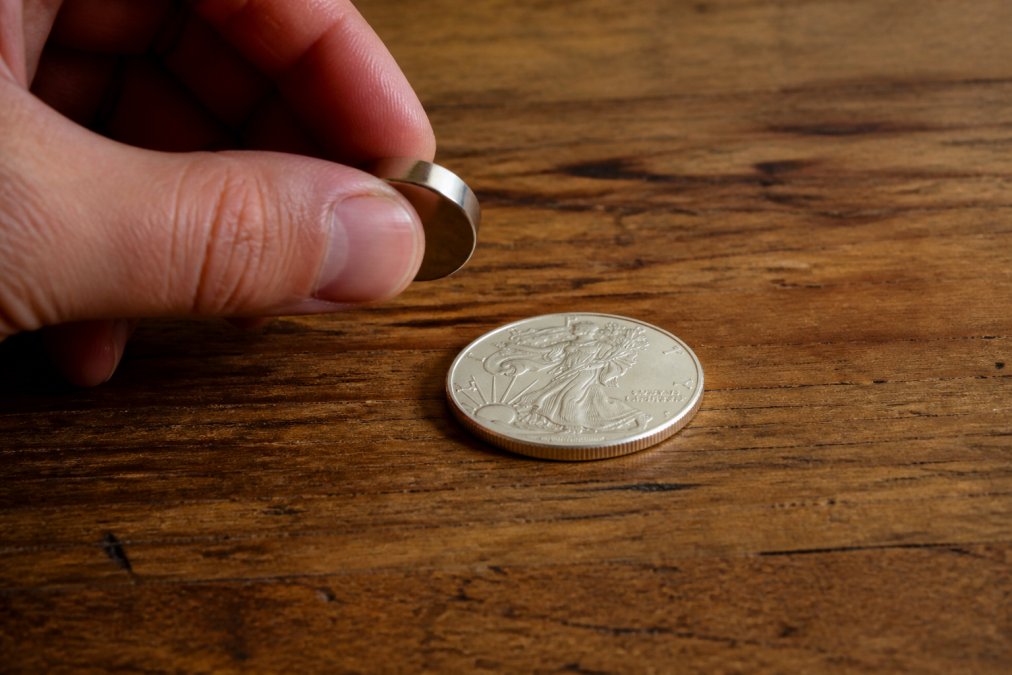
The Magnet Test: Why Real Silver Won't Stick
Here's how to run it:
- Place the coin flat on a clean surface
- Lower the magnet slowly toward the coin
- Watch for any pull, cling, or snap
- Real silver: nothing happens
- Fake silver: the magnet jumps or sticks
How to Spot Fake Silver Bullion: The Ping Test and Sound Analysis
The silver coin ping test is the second check, catching fakes the magnet misses. Real silver rings with a long, high, clear tone when balanced on your fingertip and struck with another coin. Copper and zinc fakes sound dull and short.
Try this:
- Balance the coin on your fingertip
- Tap the edge with another coin or a pen
- Listen for a clear, sustained ring
- A dull thud points to a fake
Silver Coin Weight and Dimensions: Verification with a Digital Scale
Weight is where most fakes fall apart. A genuine silver coin weighs exactly what the mint specifies, down to a fraction of a gram. Counterfeits are usually too light or too heavy, and the deviation is often large enough to catch with a modest scale.
Choosing the Right Scale
Use a digital scale with 0.01 g resolution and at least 200 g capacity. A kitchen scale reading to 1 g won't resolve the differences that matter, a fake can land within a gram of the real weight and only be exposed at the 0.01 g level. Look for a built-in calibration mode and a draft shield or leveling bubble; a scale on an uneven surface or near a draft will drift between readings.
Calibrating for Precision
Calibration is the step most home guides skip, and it decides whether your numbers mean anything.
- Power the scale on and let it warm up for 30 to 60 seconds.
- Enter calibration mode per the manufacturer's instructions.
- Place the supplied calibration weight, usually 50 g or 100 g, on the pan.
- Wait for the scale to accept the weight and confirm.
- Remove the weight and verify the scale returns to zero.
- Re-weigh the calibration weight once more to confirm it reads true.
Reading the Result
Weigh the coin three times and average the readings, a single reading can be off by a hundredth of a gram or more due to static or vibration. If the three readings disagree by more than 0.02 g, check the surface, draft, and calibration before trusting the number.
| Coin | Weight | Diameter | Purity |
|---|---|---|---|
| Silver dollar (Peace/Morgan) | 26.73 g | 38.1 mm | 90% silver |
| 1 oz silver bar | 31.10 g | Varies | .999 fine |
| Silver round | 31.10 g | 39 mm | .999 fine |
| 1967 Canadian silver dollar | 23.33 g | 36.0 mm | 80% silver |
Measuring Diameter and Thickness
Use digital calipers, not a ruler. Measure across the widest point at three angles and average, then measure thickness at the rim, not the center, the center is often raised and reads thick. A coin that weighs correctly but measures undersized is a red flag: some counterfeiters use a thinner planchet and wider strike to hit target weight while skimping on metal.
Interpreting Borderline Readings
A coin 0.05 g off is not automatically fake, wear, cleaning, and environmental exposure remove small amounts of metal over decades. A coin 0.5 g off, or off in the same direction as a known counterfeit batch, is a different story. When a reading is borderline, run the specific gravity and ping tests before concluding. Weight is a screen, not a verdict.
Visual Inspection and Hallmark Identification
Look closely before you weigh anything. A hallmark is the small stamp showing purity and maker, and counterfeits often get it wrong.
Check these details:
- Sharpness of the strike, especially fine lettering
- Edge reeding, the ridges around the rim
- Mint mark placement
- Patina that looks natural, not painted on
- Spelling errors or odd fonts
The Ice Cube Test and Thermal Conductivity
Silver moves heat faster than almost any common metal, a property called thermal conductivity, which the ice cube test uses. Place an ice cube on the coin: on real silver it melts fast because the metal pulls heat from it quickly; on a fake, the ice sits there. This test is a rough quick screen that works better on larger pieces like bars, since small coins don't show the difference as clearly.
2024 US Mint Morgan Silver Dollar $1 →
Specific Gravity Testing: The Density Check
Specific gravity is the most reliable home test and the hardest to fake. It compares a coin's density to water's. Real silver has a known density, and a counterfeit with a different metal inside will miss that number, often by a wide margin.
Why It Works
Density is a property of the metal itself, not the surface. A copper core plated with silver still has copper's density, not silver's. A tungsten slug, sometimes used to match gold's density, is close to gold but far from silver, so it fails on a silver coin. The only way to pass is a metal or alloy with silver's density, which is expensive and rare in counterfeiting because cheaper fakes use copper, zinc, nickel, brass, or lead.
The Method
- Weigh the coin dry on your digital scale. Record the number to 0.01 g.
- Fill a cup with room-temperature distilled water and set it on the scale. Zero the scale.
- Suspend the coin by a thin thread so it hangs fully underwater without touching the bottom or sides of the cup.
- Record the underwater weight, this is the buoyant weight.
- Divide the dry weight by the underwater weight.
Distilled water matters, tap water's dissolved minerals change its density slightly, and a bubble clinging to the coin throws the reading off. Add a drop of dish soap to break surface tension if bubbles persist.
Reading the Result
For pure silver, the result lands near 10.5; sterling silver sits around 10.3. A copper or zinc fake reads far off, copper near 8.9, zinc near 7.1, lead near 11.3. A reading of 10.5 on a coin that should be sterling is itself a red flag, suggesting the coin is not the alloy it claims to be.
| Metal | Approximate Specific Gravity |
|---|---|
| Fine silver (.999) | 10.49 |
| Sterling silver (.925) | 10.36 |
| Copper | 8.96 |
| Zinc | 7.13 |
| Nickel | 8.90 |
| Lead | 11.34 |
| Brass | 8.4-8.7 |
Common Errors
- Air bubbles on the coin or thread. Tap the cup gently or add a drop of soap.
- Coin touching the cup. The reading will be too high. Reposition and re-weigh.
- Thread weight. A thick thread adds measurable buoyancy. Use the thinnest thread you can handle.
- Scale drift. Re-zero between the dry and wet weighings.
- Wrong water temperature. Density changes with temperature. Use room-temperature water and be consistent.
Safety Precautions
Some counterfeit coins contain toxic lead or cadmium in the plating or core, so repeated unprotected handling is a real risk.
- Wear nitrile gloves when handling suspect coins.
- Do not eat, drink, or touch your face while testing.
- Wash your hands thoroughly with soap and water after handling, even if you wore gloves.
- Keep suspect coins away from children and pets.
- Store suspect coins in a sealed bag or container, separate from your verified collection.
- If a coin smells unusually metallic or leaves a residue on your fingers, stop handling it until you can test it properly.
Specific gravity is the strongest single home test, but it is not infallible. A counterfeit made from an alloy engineered to match silver's density would pass. Such fakes are rare because the alloy is more expensive than the silver it imitates, but they exist. Combine this test with the ping test and visual inspection before concluding a coin is genuine.
Common Counterfeit Red Flags and Materials
Most fakes are cheap base metals plated with a thin silver layer, the plating fools the eye for a second, then gives itself away.
Watch for these red flags:
- Copper or brass core with silver plating
- Zinc or nickel alloys that ring dull
- Tungsten used to match gold's density, though rare in silver fakes
- Wrong weight for the stated size
- Magnetic pull from an iron core
- Soft details and sloppy edges
No single test proves a coin is real. Stack the magnet, ping, weight, and density checks together. When three or more agree, you can trust the coin.
Frequently Asked Questions
What is the most reliable way to test silver at home?
No single test is foolproof, but combining several methods gives you confidence. Start with the magnet test: real silver is non-magnetic, so a neodymium magnet should slide off without sticking. Then check weight and dimensions against official mint specs using a calibrated digital scale. The ping test adds another layer; a genuine silver coin rings with a clear, high-pitched tone. For bullion, verify the specific gravity and look for proper hallmarks. If multiple tests pass, the coin is likely authentic.
Do magnets stick to real silver coins?
No, silver is non-magnetic. A strong neodymium magnet will not stick to a genuine silver coin. However, some counterfeit coins are made with a copper or brass core, which are also non-magnetic, so a magnet alone won't catch them. Use the magnet test as a quick first check, then confirm with weight and dimension measurements. If a magnet sticks, the coin is definitely fake.
How does the ice cube test work for silver?
Silver has the highest thermal conductivity of any metal, so it transfers heat rapidly. Place an ice cube on a silver coin and it should start melting almost immediately, often within seconds. On a fake coin made of base metal or alloy, the ice melts much slower. This test works best on larger coins or bars. Keep in mind that other metals like copper also conduct heat well, so use this alongside weight and dimension checks.
Can you use a digital scale to identify counterfeit silver?
Yes, a calibrated digital scale is one of the most reliable tools. Every genuine coin has a specific weight in troy ounces or grams. For example, a 1923 Peace Silver Dollar should weigh 26.73 grams. If the weight is off by more than a small tolerance, the coin is likely fake. Always calibrate your scale before testing and compare against official mint specifications. Combine weight with diameter and thickness measurements for a thorough check.