

Table of Contents
- What You'll Need Before You Start Testing
- Step 1: Run a Visual Inspection for Gold Bullion Authenticity
- Step 2: How to Spot Fake Gold Bars With Simple At-Home Tests
- Step 3: Check Serial Numbers and Gold Bullion Security Features
- Step 4: Verify Royal Canadian Mint Bullion DNA and Digital Authentication
- Step 5: When to Get a Professional Appraisal or Assay
- Counterfeit Indicators by Mint and Your Legal Recourse
- Conclusion
- Frequently Asked Questions
Last Updated: September 28, 2026
What You'll Need Before You Start Testing
Learning how to verify gold bullion authenticity starts with a simple truth: no single test proves a bar is real. You need several checks that point the same way. At MMmetalsandmore, we tell every first-time buyer the same thing. Run the free tests first, then pay for a professional assay when the stakes are high.
Gather these tools before you touch the metal:
- A jeweler's loupe or magnifying glass
- A strong neodymium magnet
- A digital scale accurate to 0.01 grams
- A graduated cylinder or narrow measuring cup
- A soft cloth and good lighting
Step 1: Run a Visual Inspection for Gold Bullion Authenticity
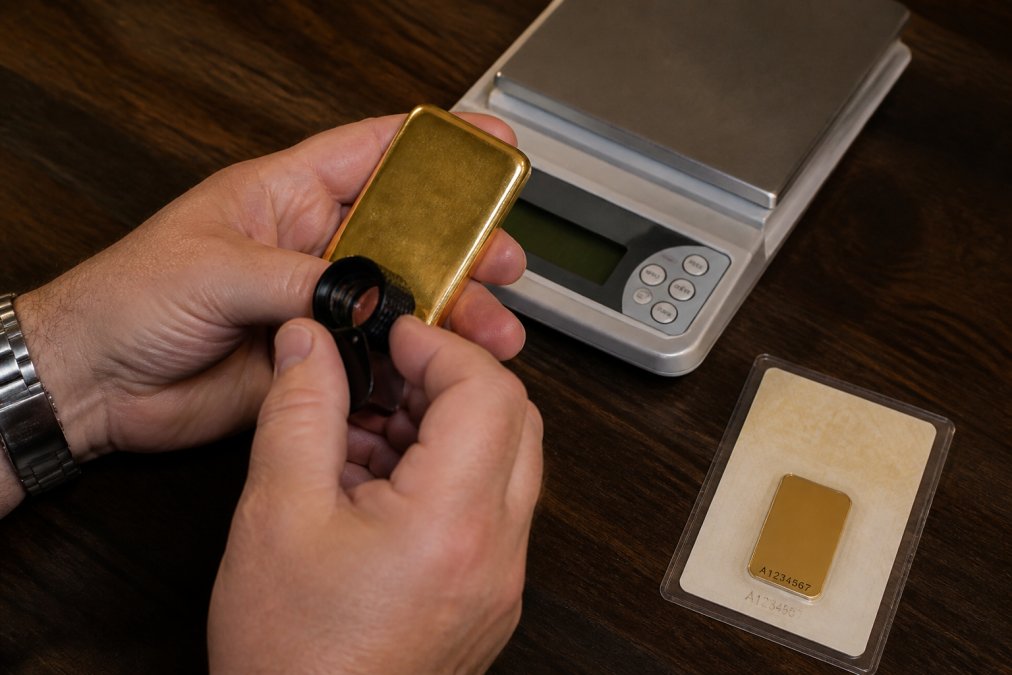
Visual inspection is the fastest way to catch a fake. A real bar has crisp stamps, clean edges, and even color. Fakes usually show blurry lettering, wavy surfaces, or a dull finish.
Hallmarks, Karat Stamps, and Edge Reeding
A hallmark is the official stamp showing who made the bar and what it contains. Real bullion carries a maker's mark, a purity stamp, and often a serial number.

Look for these marks:
- Purity stamps like "999.9" or "9999 fine gold"
- The mint's name or logo
- A serial number, stamped deep and even
- Straight, uniform edge reeding on coins
Step 2: How to Spot Fake Gold Bars With Simple At-Home Tests
Two household tests catch most counterfeits. Neither one damages the bar, so you can run them on any piece you own.
The Magnet Test and Magnetic Susceptibility
Gold is not magnetic. A strong magnet should slide off a real bar with no pull at all. If the magnet sticks, the bar contains iron or steel. If it drags slightly, suspect a tungsten core.
Specific Gravity Test and Water Displacement
The specific gravity test compares a bar's weight to the water it pushes aside. Pure gold has a density of about 19.3 grams per milliliter. Tungsten sits near 19.25, which is why it fools so many people.
Here is the method:
- Weigh the bar on your digital scale. Record the grams.
- Fill the cylinder with water and note the level.
- Lower the bar in and record the new level.
- Subtract the starting level from the new one. That is the volume in milliliters.
- Divide the weight by the volume.
Step 3: Check Serial Numbers and Gold Bullion Security Features
Serial numbers are the easiest gold bullion security features to check, but only if you know what the number is supposed to do. On most minted bars, the serial is not decoration. It is a record that ties the physical bar to a specific assay certificate, and in some cases to a mint-side database.
How Serial-to-Assay-Card Matching Actually Works
When a mint strikes a bar, it assigns a unique number and prints that same number on the assay card sealed with the bar. The card is the bar's birth certificate. If the two do not match, one of them is fake or the pair has been swapped.
Run these checks in order:
- Confirm the number on the bar matches the card character-for-character, including any prefix letters
- Check the font. Mints use consistent typefaces; counterfeiters often mix fonts between the bar and the card
- Look for deep, clean stamping. Laser-etched numbers on a cast bar are a red flag unless the mint uses that method
- Inspect the tamper seal for cuts, resealing, or a card that slides out of its sleeve
- Scan any QR code or verification code the mint provides and confirm it resolves to the mint's own domain, not a lookalike
Tamper-Evident Packaging and What It Tells You
Most major mints ship bars in sealed CertiCard-style packaging. The seal is designed so that opening it leaves visible evidence. A resealed card, a wrinkled laminate, or a serial that does not line up with the window cutout all point to tampering.
Micro-Engraving, Holograms, and Laser Marks
Modern bullion uses several overt and covert features:
- Micro-engraved text that is only legible under magnification
- Laser-applied security marks that change appearance at different angles
- Holograms that are difficult to reproduce at low cost
- Latent images that appear only when the bar is tilted
These features raise the cost of counterfeiting, but they are not proof on their own. A skilled counterfeiter can replicate a hologram. Use them as one signal among several, and pair them with the digital authentication covered in the next section.
Step 4: Verify Royal Canadian Mint Bullion DNA and Digital Authentication
The Royal Canadian Mint Bullion DNA system gives every Gold Maple Leaf a unique surface pattern. The mint reads that pattern with a handheld scanner and confirms the coin is genuine in seconds.
Here is how the system works:
- Each coin gets a digital fingerprint at the mint
- Authorized dealers carry scanners that read the pattern
- The scanner matches the coin against the mint's database
- A mismatch means the coin is not genuine
Step 5: When to Get a Professional Appraisal or Assay
Get a professional assay when the value is high, the seller is unknown, or your own tests gave mixed results. An assay is a lab test that measures the metal's exact purity and weight.
Non-Destructive Testing: XRF, Ultrasonic, and Density Checks
Non-destructive testing confirms purity without harming the bar. Three methods cover most cases:
| Method | What It Finds | Best For |
|---|---|---|
| X-ray fluorescence (XRF) | Surface purity and alloy mix | Quick in-store checks |
| Ultrasonic testing | Internal voids and tungsten cores | Sealed or thick bars |
| Density and weight checks | Weight tolerance and dimensions | Any bar, any size |
Counterfeit Indicators by Mint and Your Legal Recourse
Most guides stop at the tests. This section covers what to look for on specific popular products and what to do if a test fails. That second part is the step almost no competitor explains, and it is the one that matters most once you suspect a fake.
Scottsdale Mint 1/100 oz Gold Cross Bar →
Counterfeit Indicators by Mint
Different mints have different weak spots. Knowing them helps you spot fakes faster and gives you specific language when you report a seller.
-
Gold Maple Leaf: weak or missing radial lines behind the maple leaf, a Bullion DNA pattern that does not match the mint's record, and a date font that looks slightly wider or softer than a genuine coin
-
PAMP Suisse bars: a blurry or poorly defined Fortuna figure, a loose or resealed assay card, and a serial that does not match the card font
-
Generic or private-mint bars: inconsistent weight tolerance, wavy surfaces, and purity stamps that use the wrong decimal format
Destructive vs. Non-Destructive Testing: Which to Choose
Before you escalate, decide whether you are willing to damage the piece. This is the distinction most guides blur.
-
Visual inspection under magnification
-
Magnet test
-
Specific gravity and water displacement
-
X-ray fluorescence (XRF) surface scan
-
Ultrasonic thickness and internal-structure check
-
Digital authentication such as the Royal Canadian Mint Bullion DNA scanner
-
Acid testing, which scratches the surface
-
Fire assay, which melts a sample
-
Cut or drilled core sampling
What to Do If You Discover a Fake
Act quickly. Delay weakens both your fraud report and any civil claim.
- Stop the transaction. Do not resell or move the bar. Reselling a known counterfeit can expose you to liability.
- Preserve everything. Keep the bar, the assay card, the packaging, the receipt, the listing, and every email or message with the seller.
- Document the piece. Photograph the bar, the card, the packaging, and any serial numbers under good lighting.
- Get a written opinion. A professional assay or a written assessment from a qualified appraiser gives you evidence, not just suspicion.
- Report the seller. File a report with the Canadian Anti-Fraud Centre. If the sale involved deceptive marketing, the Competition Bureau of Canada accepts complaints as well. Competition Bureau of Canada's guidance on deceptive marketing
- Notify the platform. If you bought through an online marketplace or auction site, open a dispute immediately and reference your documentation.
- Consider a civil claim. For larger losses, a civil claim may recover your money. Talk to a lawyer early, because limitation periods apply and evidence degrades over time.
Conclusion
A fake bar can pass one test and fail the next, so stack your checks: visual inspection, magnet, density, serial number, and a professional assay when the value justifies it. Buying from a trusted source removes most of that risk before it starts.
Frequently Asked Questions
Can I check my gold bar serial number to confirm it's real?
Yes. Most modern minted bars carry a unique serial number stamped on the face and repeated on the assay card. Match the two, then verify the number with the mint or an authorized dealer. Sealed packaging from mints like Scottsdale or PAMP Suisse ties the bar to its certificate, so a mismatched or missing number is a red flag. Serialization alone doesn't prove gold bullion authenticity, but it is a fast first check before you move to weight and density tests.
What is the fastest way to test the authenticity of gold?
Start with weight and dimensions against the stated specification, then use the magnet test. Gold is not magnetic, so a strong magnet should not pull the bar. For a stronger signal, the specific gravity test compares the bar's density to pure gold's expected density. These checks take minutes and need no special equipment. If anything is off, move to non-destructive testing such as X-ray fluorescence at a dealer or appraiser before you buy or sell.
Does the Royal Canadian Mint offer bullion authentication services?
For bars and coins from other mints, authentication falls to a qualified appraiser, assay lab, or authorized bullion dealer using tools like XRF and ultrasonic testing. If you buy from a reputable dealer, ask what verification they perform and whether a written guarantee or certification accompanies the piece.
What should I do if I discover I bought a fake gold bar?
Stop any resale, keep the bar, packaging, receipt, and all correspondence, and get a written assessment from a qualified appraiser. Report the matter to your local police and to the Canadian Anti-Fraud Centre. If you paid by credit card, contact your issuer about a chargeback. For consumer protection questions, the Competition Bureau handles deceptive marketing complaints. Acting quickly with documentation gives you the best chance of recovery and helps investigators trace the source.