

Table of Contents
- How to Store Silver Bars Safely: Security and Preservation Basics
- How to Store Silver Bullion at Home
- Silver Bar Storage Temperature and Humidity
- How to Prevent Silver Bars from Tarnishing
- Best Containers for Storing Silver Bars
- Insurance, Documentation, and Emergency Access
- Frequently Asked Questions
Last Updated: October 12, 2026
How to Store Silver Bars Safely: Security and Preservation Basics
Learning how to store silver bars safely comes down to two jobs: keeping thieves out, and keeping air and moisture away from the metal.
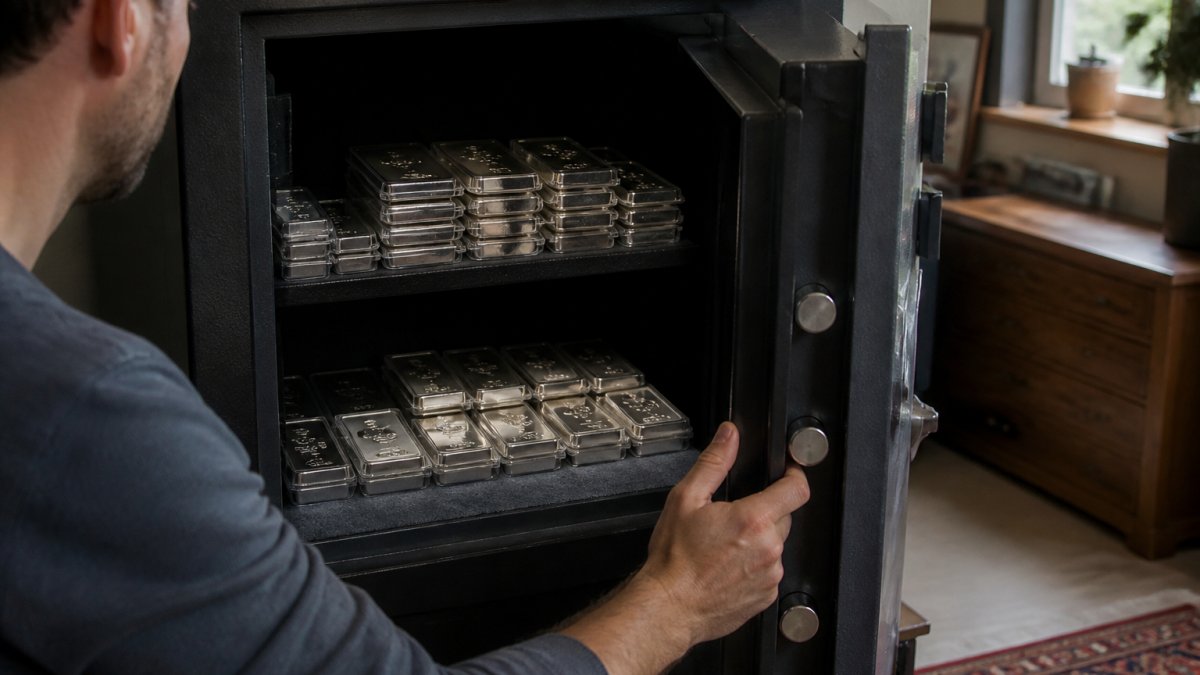
Silver is soft, reactive, and easy to trace by touch. A single fingerprint can etch itself into the surface over time, which is why storage is really two problems wearing one coat.
- Security: stopping theft, loss, and misplacement
- Preservation: stopping tarnish, scratches, and handling marks
Below, we break down home storage, containers, humidity control, and insurance so you can build a setup that fits your risk level.
How to Store Silver Bullion at Home
Storing silver bullion at home works well if you control who knows about it and where it sits. The biggest risk is not burglary itself but telling people you own bullion.
A few practical rules apply to almost every home setup:
- Keep bars out of bedrooms, which burglars search first
- Avoid obvious spots like sock drawers and freezer doors
- Split larger holdings across two or more locations
- Store an inventory list somewhere separate from the metal
Smaller bars, like the Valcambi Wallet with 24 x 1g Silver CombiBars, are easier to divide across locations because each 1-gram segment snaps off and stores separately. Larger bars are harder to steal and harder to relocate.

Home Safes vs. Bank Deposit Boxes vs. Bullion Vaults
Each storage option trades off access, cost structure, insurance treatment, privacy, and disaster exposure. There is no single winner, only the one that matches your situation.
| Factor | Home Safe | Bank Deposit Box | Bullion Vault |
|---|---|---|---|
| Access | 24/7, immediate | Branch hours only | Scheduled appointments or online portal |
| Cost structure | One-time purchase plus anchoring | Annual rental fee set by the institution | Ongoing storage fee, often a percentage of value |
| Insurance | Usually needs a rider or separate policy | Typically not covered by the bank; you insure it yourself | Vault operator may carry insurance, but verify what it covers |
| Privacy | Fully private | Institution knows the contents category | Operator knows the contents |
| Disaster exposure | Fire, flood, and theft at one address | Fire, flood, and institutional failure at one branch | Concentrated at one facility, but purpose-built |
| Access continuity | Depends on you sharing the combination | Depends on estate or joint-holder arrangements | Depends on the operator staying solvent |
A home safe gives round-the-clock access, which matters if you want to sell quickly. A bank deposit box adds institutional security but ties access to branch hours and does not insure contents by default.
Safe Installation and Concealment Trade-offs
Where you put the safe matters as much as which safe you buy:
- Anchor it. A safe that is not bolted to a concrete floor or wall studs can be carried out whole. Bolt-down kits are inexpensive and widely available.
- Avoid the master bedroom and home office. These are the first rooms a burglar searches. A safe in a basement utility area or a closet behind stored goods is less obvious.
- Do not hide it in a predictable spot. False-bottom drawers, freezer doors, and toilet tanks are the first places experienced thieves check.
- Weigh fire and flood exposure. A basement safe is hidden but sits in the path of water. A ground-floor safe is drier but more visible. A fire-rated safe buys time against heat, not against a determined burglar.
Emergency Planning and Access Continuity
A storage plan that only works while you are healthy and present is incomplete. Think through fire, flood, evacuation, extended power loss, or your own incapacity.
- Fire and flood: Keep the metal above expected flood lines and away from exterior walls. If you evacuate, you cannot carry a heavy safe, so the metal stays behind, which is why splitting holdings across locations matters.
- Power loss: Electronic locks and keypad safes fail without power. Keep a mechanical key or a backup entry method accessible off-site.
- Loss of access: If you are hospitalized or traveling, a trusted person needs a way to reach the metal and the paperwork. A sealed letter with a lawyer, or a joint-access arrangement, covers this.
- Backup records: Store a duplicate inventory, photos, and serial numbers somewhere other than the storage location, a cloud folder, a lawyer's office, or a relative's home.
A common pattern is to keep the metal in one place and the paperwork in another, so a single event cannot take both.
Silver Bar Storage Temperature and Humidity
Silver bar storage temperature and humidity matter more than most owners realize.

What to aim for:
- Low humidity: under 50% relative humidity is a common target
- Stable temperature: room temperature, kept steady
- No damp rooms: skip basements and bathrooms
- Airflow: a sealed container beats an open shelf
A simple hygrometer, the same device used for cigar humidors, tells you exactly what your storage space is doing. Check it monthly.
Moisture is the enemy, not cold or heat on their own. A garage that swings from freezing to warm will pull moisture onto cold metal. That is how silver starts to discolor.
How to Prevent Silver Bars from Tarnishing
Tarnish is surface oxidation, not damage to the silver itself.
The main causes of tarnish:
- Sulfur in the air, from rubber, wool, and certain paints
- Humidity, which speeds up the reaction
- Skin oils, left behind by bare hands
- Reactive plastics, especially PVC
Keep bars away from rubber bands, cardboard, and anything that smells like a tire shop. Those materials off-gas sulfur compounds that attack silver directly.
A sealed container plus a dry environment handles most of the problem. Add an anti-tarnish strip or silica packet for extra protection, and replace it on a schedule.
Handling Tips to Avoid Fingerprints and Surface Damage
Never touch a silver bar with bare hands. Skin oils and salts leave permanent marks that etch into the surface over months. Wear cotton gloves, or hold the bar by its edges only.
Valcambi Wallet with 24 x 1g Silver CombiBars (.999 Fine) →
More handling rules to follow:
- Hold bars over a soft surface, never over tile or concrete
- Keep bars in their original packaging when possible
- Do not stack loose bars against each other
- Use a soft cloth, never a paper towel, if you must wipe one
- Store collectible pieces separately from bulk bars
Original assay packaging is worth keeping. The PAMP Suisse USA 250th Anniversary 1 oz Fine Silver Bar ships sealed in a tamper-evident assay card, which ties the certificate number to the bar and protects the surface.
Best Containers for Storing Silver Bars
The best containers for storing silver bars are airtight, PVC-free, and sized so bars do not rattle against each other. Look for polyethylene or polypropylene plastic, Mylar bags, or cotton and tissue wrapping.
Containers to use:
- Mylar bags with a heat seal for long-term storage
- Polyethylene boxes or tubes for stacking
- Cotton flips or acid-free tissue for individual coins
- Airtight cases with a gasket seal
- Silica gel packets to absorb moisture
Containers to avoid:
- PVC plastic, which releases chlorine and attacks silver
- Rubber bands, which leave sulfur marks
- Cardboard boxes, which are acidic over time
- Open trays, which expose bars to air and dust
Small bars like the Pan Silver Co 5 Gram Astronaut Deep Space Bar come factory-sealed in their original box, keeping the fractional silver uncirculated and free from toning.

For a full storage setup, work through this checklist:
- Choose a dry, low-traffic location
- Add a safe or locked container
- Wrap each bar in acid-free tissue or a Mylar bag
- Add a silica packet to the container
- Label the container without naming the contents
Insurance, Documentation, and Emergency Access
Insurance and paperwork are the parts most owners skip, and they matter most after a loss. A standard home policy often treats bullion as a sub-limit category, capping the payout well below the metal's value, or excludes it outright. Ask your insurer directly and get the answer in writing.
How Bullion Is Treated Under a Home Policy
Most home policies handle precious metals in one of three ways:
- Sub-limit: The policy covers bullion, but only up to a fixed amount that is usually far below a meaningful stack. Anything above that ceiling is uninsured.
- Exclusion: The policy does not cover bullion at all, and you need a separate policy or endorsement.
- Scheduled rider: You list specific items or a total value, pay an additional premium, and the insurer covers them up to the scheduled amount. This is the most common way to get real coverage.
When you call your insurer, ask these questions and write down the answers:
- Is bullion covered under my current policy, and if so, what is the sub-limit?
- Do I need a rider, endorsement, or separate policy to cover the full value?
- Does the policy require a specific storage method, such as a rated safe or a bank deposit box, as a condition of coverage?
- What proof of ownership is required to file a claim?
- Does the policy cover tarnish, scratches, or handling damage, or only theft and loss?
Insurers typically require receipts, serial numbers, and photographs before paying a claim. Without those, a claim can be denied or reduced.
Documentation to Keep, Stored Away from the Metal
- Purchase receipts with dates, amounts, and dealer names
- Photos of each bar, front and back, with the serial number visible
- Serial numbers and weights recorded in a written inventory
- A running total value, updated when you buy or sell
- Appraisals for any collectible or graded pieces
Keep the inventory in a spreadsheet or notebook, with a duplicate somewhere other than the storage location, a cloud folder, a lawyer's office, or a relative's home. One event cannot then destroy both the metal and the proof you owned it.
Emergency Access and Continuity
Emergency access deserves its own plan. If something happens to you, your family needs to find the metal and the paperwork. Tell one trusted person where both are kept, or leave sealed instructions with a lawyer.
A safe deposit box or a lawyer's office is a good home for the paperwork, with the metal somewhere else entirely, so a single event cannot take both.
Frequently Asked Questions
What is the safest way to store silver bars?
The safest method combines a fireproof home safe bolted to the floor with silica gel packs and airtight containers. For larger holdings, a bank deposit box or specialist bullion vault offers higher security. Always store bars away from high-traffic areas and keep documentation separate from the metal itself.
Should silver bars be stored in plastic?
Yes, but only PVC-free plastic. PVC contains sulfur that accelerates tarnish. Use Mylar sleeves, polyethylene bags, or original assay cards. Avoid soft vinyl holders often sold for coins. If your bar came in a sealed assay card from a refinery, leave it sealed for maximum protection.
How do you keep silver bars from tarnishing?
Control humidity below 50 percent, use silica gel packs, and store bars in airtight containers with sulfur-absorbing strips. Handle with cotton gloves to prevent oils from triggering tarnish. Keep bars away from rubber bands, wool, and certain woods that emit sulfur compounds.
Can silver bars be stored in a safe at home?
Yes, a home safe is a practical option for many investors. Choose a fireproof model bolted to a concrete floor or wall studs. Place it in a discreet location. For high-value holdings, consider a bank deposit box or a specialist vault for added security and insurance benefits.
Storing silver well takes a plan, not just a safe. Theft, tarnish, and lost paperwork are all preventable, and each one costs you money if ignored. At MMmetalsandmore, we stock premium silver bullion and collectible coins with secure shipping and professional service, so your metal arrives in the condition you paid for. Browse our silver selection and start building a storage setup that protects both the metal and the paperwork behind it.