

Table of Contents
- Where to Sell Silver Coins Safely
- Numismatic Value vs Melt Value: Which One Applies to Your Coins
- How to Verify Silver Coin Authenticity Before You Sell
- Tax Implications of Selling Silver Bullion
- Step-by-Step: How to Sell Silver Coins Safely
- Common Mistakes When Selling Silver
- Conclusion: Selling Silver Coins Safely
- Frequently Asked Questions
Last Updated: September 22, 2026
Where to Sell Silver Coins Safely
Learning how to sell silver coins safely starts with knowing your options. You can sell to a local coin shop, a trusted online bullion dealer, or a private buyer. Each route carries different risks and payouts.

| Method | Speed | Typical Payout | Best For |
|---|---|---|---|
| Local coin shop | Same day | Lower | Fast cash, small lots |
| Online bullion dealer | 3-7 days | Higher | Larger collections |
| Private sale | Varies | Highest | Rare or numismatic coins |
Local Coin Shops vs. Online Bullion Dealers
Local shops offer convenience and instant payment. You walk in, get an offer, and leave with cash. The trade-off is a wider dealer markup, since the shop needs room to resell.
Numismatic Value vs Melt Value: Which One Applies to Your Coins
Melt value is what your coin's silver is worth at the current spot price. Numismatic value is what a collector will pay based on rarity, age, and condition. Most coins sell for melt value. Only rare pieces earn a collector premium.
Here's how to tell them apart:
- Common circulated coins: melt value only
- Silver rounds and bars: melt value plus a small premium
- Rare dates or low mintage: possible numismatic value
- Graded coins in holders: numismatic value, often higher
How to Verify Silver Coin Authenticity Before You Sell
Most guides tell buyers how to spot fakes. Sellers need the same skill set, because a counterfeit you unknowingly pass on can void a sale, trigger a dispute, or expose you to a fraud claim. Verify your own coins before you list them, and document what you did.

The four-test baseline
Run every coin through these before it goes to market:
- Weight. Use a jeweller's scale accurate to 0.01 g. A 1 oz silver round should read 31.1 g. A pre-1967 Canadian silver dollar should read 23.33 g. A 1967 or 1968 dime should read 2.33 g. If a coin is more than about 0.1 g off spec, set it aside.
- Dimensions. Calipers catch the most common fakes, which are struck on undersized or oversized planchets. Compare diameter and thickness against a known genuine example of the same date and mint.
- Magnetism. Silver is not magnetic. A strong rare-earth magnet should slide off the surface with no pull. A coin that sticks is steel-cored. A coin that repels strongly may be plated over a magnetic core.
- Visual detail. Genuine strikes have crisp rims, sharp lettering, and defined hair or feather detail. Fakes show soft edges, doubled lettering, or a seam on the edge.
The tests that actually catch good fakes
Basic tests fail against high-quality counterfeits, which are common in silver dollars, silver eagles, and popular bullion rounds. For anything worth more than a few dollars over melt, add:
- Specific gravity test. Weigh the coin dry, then weigh it suspended in water. Divide dry weight by the difference. Fine silver reads about 10.49. Sterling reads about 10.36. A copper- or brass-cored fake reads noticeably lower. This is the single most reliable home test for solid fakes.
- Ping test. Balance the coin on a fingertip and tap the edge with another coin. Genuine silver rings with a sustained, high tone. A dull thud suggests a base-metal core. This is a screen, not proof, a worn or bent genuine coin can also sound flat.
- Acid test. Only use this on a coin you have already decided is bullion-grade. A drop of 18K or 22K testing acid on a filed edge turns the expected color for silver. It is destructive, so never use it on a coin with numismatic potential.
- Sigma-style tester or XRF. A precious-metal verifier or X-ray fluorescence scan gives a non-destructive purity reading. Many local coin shops and pawn shops will run a coin for free or for a small fee. Ask before you list a high-value piece.
What to do when a coin fails
Do not try to sell a coin you believe is counterfeit. In most provinces, knowingly passing counterfeit currency or counterfeit precious-metal items can expose you to civil liability and, depending on the item, criminal liability under the Criminal Code. Set the coin aside, label it clearly, and if you bought it from a dealer, contact that dealer with your test results and photos.
Document your verification
Keep a simple log for each coin you plan to sell:
- Weight, diameter, and thickness readings
- Specific gravity result, if you ran it
- Photos of the coin on the scale and beside a genuine comparison
- Name of any shop or tester that ran an XRF or assay, plus the date
Tax Implications of Selling Silver Bullion
Selling silver can trigger a tax bill, and the rules depend on what you sold, how long you held it, and whether the buyer is a business. Plan before you sell, not after.
GST/HST on the sale
Investment-grade silver bullion, bars, rounds, and coins that meet the purity and form requirements, is generally zero-rated for GST/HST. That means you do not charge GST/HST on the sale, and you do not pay it on the purchase. Numismatic or collectible coins that do not meet the investment-grade definition are typically taxable.
Capital gains on the profit
When you sell silver for more than your adjusted cost base, the difference is a capital gain. The taxable portion is included in your income at the capital gains inclusion rate for the year of the sale. Your adjusted cost base is what you paid, plus costs directly tied to the purchase, such as shipping and insurance.
A few mechanics that matter:
- Pooling. If you bought silver in several lots at different prices, you generally pool them and use the average cost as your adjusted cost base, rather than tracking each coin separately.
- Superficial losses. If you sell at a loss and buy the same or identical property within 30 days before or after the sale, the loss is denied for tax purposes. This catches sellers who try to harvest a loss and immediately rebuy.
- Reporting. Capital gains and losses are reported on Schedule 3 of your T1 return. You do not need to report the sale itself on a separate form unless the buyer issues one.
- Dealer reporting. Businesses that buy precious metals in the course of their business may be required to report certain purchases to the Canada Revenue Agency. Ask your buyer whether they will issue a receipt or report the transaction, and keep your own copy regardless.
Records to keep
Keep these for at least six years from the end of the tax year in which you sold:
- Purchase receipts showing date, quantity, and price per unit
- Shipping, insurance, and assay costs tied to the purchase
- Sale records showing date, buyer, quantity, and price
- Appraisal or assay documents
- Bank or payment records showing the funds received
When to get help
If you sold a large amount, held silver across several years, or sold both bullion and collectible coins in the same year, the pooling and inclusion rules get complicated fast. A tax professional who works with precious metals can confirm your adjusted cost base and the correct inclusion rate for your year of sale.
Step-by-Step: How to Sell Silver Coins Safely
Selling safely comes down to three steps: prepare, appraise, and complete. Follow them in order and you reduce your risk at every stage.
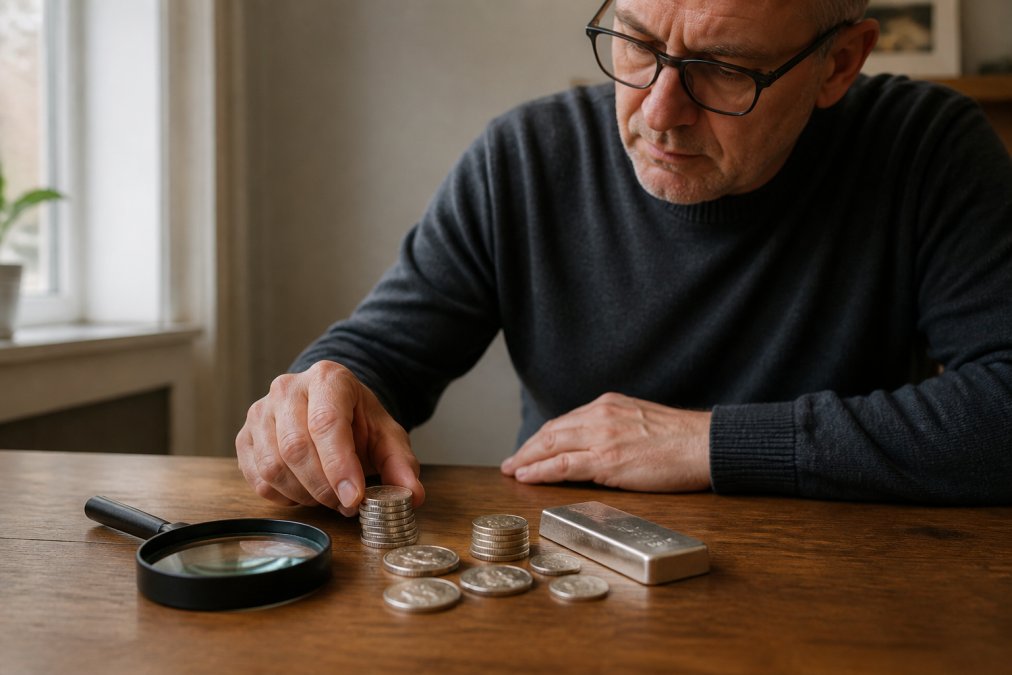
Step 1: Prepare and Photograph Your Coins
Good photos get better offers. Set up near a window with soft daylight. Use a plain background and lay coins flat.
Step 2: Get an Appraisal and Compare Offers
Get at least three offers before you sell. Ask each buyer to explain how they reached their number. A fair offer ties back to spot price and condition.
Watch for these red flags:
- A buyer who refuses to explain their pricing
- Offers far below spot for common bullion
- Pressure to sell on the spot
- No written receipt or contract
Step 3: Complete the Sale Safely
For in-person sales, meet in a public place or at the shop. Bring a friend if the amount is large. Count payment before you hand over the coins.

Common Mistakes When Selling Silver
Most sellers lose money on the same few errors. Avoid these and you keep more of your profit.
- Selling without checking spot price. Know the current price before you talk to any buyer.
- Cleaning collectible coins. It destroys value. Leave the surface alone.
- Skipping the appraisal. You cannot judge a fair offer without a baseline.
- Using uninsured shipping. If the package vanishes, you absorb the loss.
- Rushing the sale. Pressure leads to bad deals. Take your time.
Conclusion: Selling Silver Coins Safely
Selling silver takes patience and a bit of homework. Verify your coins, compare offers, and keep clean records. That way you protect both your profit and your peace of mind.
Frequently Asked Questions
Where is the safest place to sell silver coins?
Reputable local coin shops, established online bullion dealers, and verified private buyers through collector forums are the safest options. For high-value collections, choose a buyer who offers insured shipping, provides a written receipt, and has verifiable reviews. If selling in person, meet during business hours at a public location such as a bank lobby. Always get at least two independent offers before committing, and never hand over coins before payment clears.
Do I need to report selling silver coins to the CRA?
The Canada Revenue Agency treats silver bullion and coins as capital property in most cases. If you sell for more than your adjusted cost base, the gain is taxable as a capital gain, and 50% of that gain is included in your income. Collectors holding coins as part of a business inventory may face different rules. Keep purchase receipts, sale records, and any appraisal documents. Consult a tax professional for your specific situation.
Should I sell to a local coin shop or an online bullion dealer?
Local coin shops offer immediate cash and let you negotiate face to face, but their buy prices often reflect a wider dealer markup. Online bullion dealers frequently pay closer to spot price and handle insured shipping, though you wait longer for payment. For common bullion, online dealers usually win on price. For rare numismatic pieces, a specialist local dealer or auction house may get you more.
How can I avoid scams when selling precious metals?
Insist on payment before releasing coins, or use an escrow service for private sales. Avoid buyers who pressure you to ship before payment, offer prices far above spot, or refuse to provide identification. For in-person transactions, bring a companion, meet in a public place, and verify the buyer's business registration. Keep a written record of every sale, including the buyer's name, date, and amount paid.
This article is for general information only and is not tax or financial advice. Confirm your situation with a qualified professional.