

Table of Contents
- What You'll Need Before You Start Grading Rare Coins
- The Coin Grading Scale: How the 1-70 Sheldon System Works
- How to Identify Coin Wear, Contact Marks, and Luster Changes
- Coin Grading Tools That Make Self-Grading More Accurate
- A Step-by-Step Grading Workflow for Beginners
- When to Use Professional Coin Grading Services
- How Grade, Rarity, and Authentication Affect Market Value
- Conclusion
- Frequently Asked Questions
Last Updated: October 13, 2026
What You'll Need Before You Start Grading Rare Coins
Grading rare coins for beginners starts with one truth: you cannot judge what you cannot see. At MMmetalsandmore, we tell new collectors to slow down and set up properly.
Coin grading judges a coin's condition on a standard scale so buyers and sellers agree on value. Grade drives price more than almost anything else.
Here is what you need before you grade your first coin:
- A clean, well-lit desk with no clutter
- A soft cloth or felt pad to rest coins on
- A jeweler's loupe or magnifier
Setting Up a Safe, Well-Lit Workspace
Lighting decides everything. Angle a lamp low across the coin and surface marks jump out; move it overhead and they vanish.
Rest the coin on felt, never bare wood or glass, and hold it by the edges only. Skin oils etch into metal permanently.
Work over a soft surface too, a dropped coin on a hard floor becomes a damaged one in a second.
The Coin Grading Scale: How the 1-70 Sheldon System Works
The Sheldon scale is a 1 to 70 numbering system describing a coin's condition, from barely identifiable to flawless, and most collectors and dealers use it as the shared language of coin condition. Here is how it breaks down:
| Grade Range | Label | What It Means |
|---|---|---|
| 1-3 | Poor to About Good | Heavy wear, details barely visible |
| 4-7 | Good to Very Good | Major design visible, flat rims |
| 8-10 | Fine to Very Fine | Clear details, moderate wear |
| 12-15 | Fine to Choice Fine | Sharper details, light wear |
| 20-35 | Very Fine to Extremely Fine | Strong detail, minor wear on high points |
| 40-45 | Extremely Fine to Choice XF | Light wear, most detail intact |
| 50-58 | About Uncirculated | Tiny wear on the highest points |
| 60-70 | Mint State | No wear, full luster, from 60 up to flawless 70 |
The jump from 58 to 60 matters: one tiny trace of wear separates circulated from uncirculated, and that trace can double the price.
How to Identify Coin Wear, Contact Marks, and Luster Changes
Wear shows first on the highest points of a design: on a portrait, the cheek, hair over the ear, and brow; on a wreath, the leaf tips and bow; on a ship or maple leaf, the finest veins and the mast.
Beginners lump four things under "wear," and only one is wear:
- Wear: Metal rubbed away through circulation. It follows a pattern, hitting the highest points hardest and fading as you move toward the rim.
- Contact marks: Small nicks, scuffs, or bag marks from coins hitting each other or a hard surface. They sit on top of the design, not carved into it.
- Luster: The original mint shine that flows across the surface under angled light. It breaks first on the high points, then spreads.
- Strike quality: How fully the dies pressed metal into the planchet at the mint. A weak strike leaves soft details that look like wear but sit evenly across the whole design.
A Visual Diagnostic: Wear vs. Mint-Made vs. Damage
Work through these four checks in order; each rules something out.
**1.
2. Does the surface look original under angled light? Tilt the coin under a low-angle lamp.
3. Are the marks raised, recessed, or cut? Contact marks sit on the surface; gouges, scratches, and tooling cut into it.
4. Is the edge or rim compromised? Dents, bends, holes, and filed rims drop a coin below its wear grade entirely.
Common Beginner Misreads
- Mistaking a weak strike for heavy wear. A softly struck coin can look Fine when it's actually Mint State. Compare the low points, not just the high ones.
- Mistaking cleaning for luster. Freshly cleaned coins look bright, but the shine is flat and uniform instead of flowing in bands.
- Mistaking a bag mark for a gouge. A light scuff that doesn't break the metal is a contact mark; a cut that displaces metal is damage.
- Mistaking toning for dirt. Natural toning is part of a coin's surface and often adds eye appeal. Scrubbing it off destroys value.
Why This Matters for Rare Coins Specifically
On a common coin, a one-point error is annoying; on a rare coin it can swing the price dramatically because so few examples exist to absorb the mistake. When unsure whether a flat spot is wear or a weak strike, treat your grade as a range and note the uncertainty.
Coin Grading Tools That Make Self-Grading More Accurate
A loupe, good light, and a scale cover most of what you need to start grading coins at home.
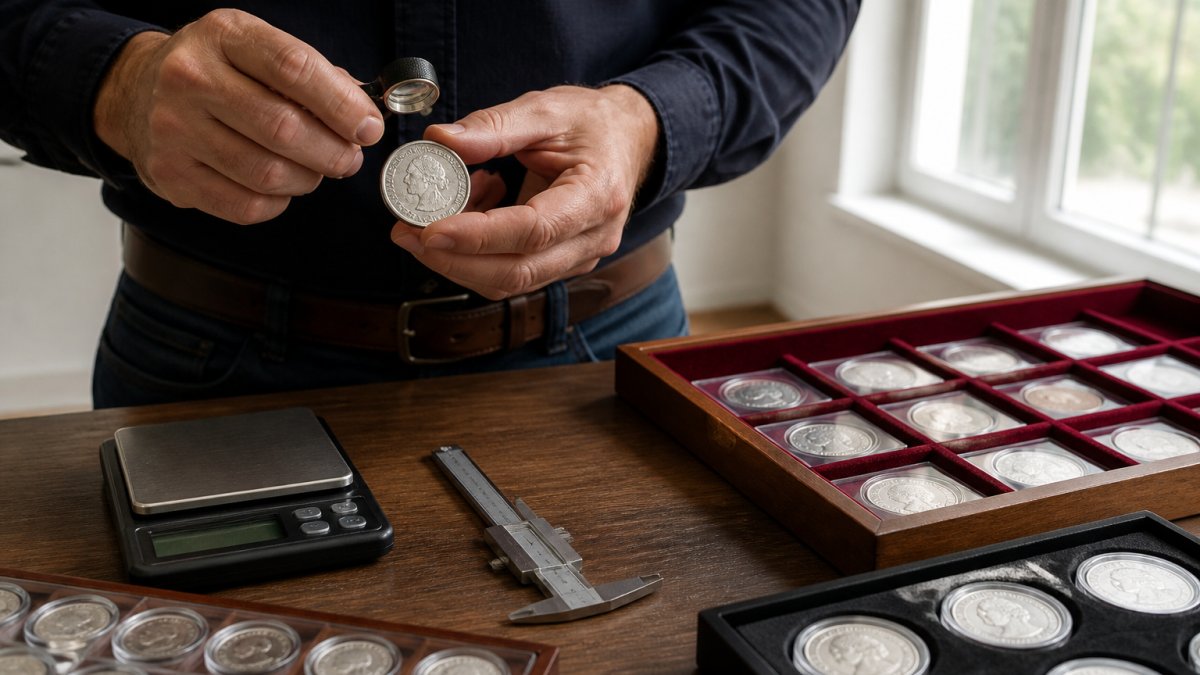
The core toolkit:
- 10x loupe: The standard magnification for spotting marks and cleaning
- Angled lamp: Side light reveals luster and surface flaws
- Digital scale: Confirms weight, which helps flag counterfeits
- Reference images: Photos of known-grade coins to compare against
Reference images do more for accuracy than any single tool: compare your coin side by side with a photo of the same date and type in a known grade, and your eye learns fast.
2024 US Mint Morgan Silver Dollar $1 – NGC MS 70 (Cert #8356031116) →
A Step-by-Step Grading Workflow for Beginners
Work through these steps in order every time, consistency separates a guess from a grade.
- Confirm authenticity first. Check weight, diameter, and the look of the rim before anything else.
- Check the high points for wear. Use a loupe on the cheek, hair, and wing tips.
- Judge the luster. Tilt the coin under angled light. Note where the shine stops.
- Count the contact marks. Look at the fields, the flat areas around the design.
- Assess eye appeal. Step back. Does the coin look clean and original, or dull and marked?
- Match it to the scale. Pick the grade band that fits, then narrow it down.
- Write it down. Record your grade, the date, and what you saw.
Then set the coin aside and grade it again the next day. If your two grades match, you are building real skill.
When to Use Professional Coin Grading Services
Professional grading pays off when a coin's value is high enough that an expert opinion changes the price. A third-party service examines the coin, assigns a grade, and seals it in a protective holder called a slab.
That slab protects the coin, certifies the grade, and makes it easy to sell later. It also shifts the burden of proof: a buyer who would haggle over your self-grade usually accepts a certified one without argument.
A Decision Framework, Not a Rule of Thumb
Run every candidate coin through these four questions first:
- Is the coin genuine? If you suspect a counterfeit or altered coin, authentication alone can justify submission. A grading service returns a fake in a "not genuine" holder, which is itself useful information.
- Does one grade point move the price meaningfully? On common coins in low grades, no. On scarce and key dates, a single point can separate two very different price tiers.
- Will you sell, insure, or hold? Certified coins sell faster and insure more cleanly. If the coin is going into a long-term collection and you trust your own eye, the case for grading weakens.
- Does the all-in cost fit the coin's value? Add up the grading tier, shipping both ways, insurance, and handling fees. If that total is a large fraction of the coin's value, the math usually doesn't work.
Submission Mechanics Beginners Should Know
- Tiers and turnaround. Most services offer economy, standard, and express tiers. Faster costs more, and turnaround estimates are estimates, not guarantees.
- Declared value. You state what the coin is worth on the submission form. That figure drives both the fee tier and the insurance ceiling, so under-declaring can leave you under-covered if the coin is lost.
- Holders and designations. Coins come back in tamper-evident slabs with a certification number you can look up in the service's registry. Some services add designations for full strikes or original surfaces.
- Conservation and details grades. A cleaned or damaged coin may come back with a "details" grade rather than a number. That's still useful, but it changes how the coin trades.
Submission Economics and Confidence Ranges
Professional grading costs money, and the fee varies by service, turnaround time, and declared value. We won't quote a number here, because fees change and depend on your submission.
Think in confidence ranges instead.
Keep a running log of your self-grades next to the certified grades you eventually receive. Over a dozen coins, you'll see whether you consistently grade high, low, or on target.
How Grade, Rarity, and Authentication Affect Market Value
Three things drive a rare coin's value: grade, rarity, and authenticity.
A common coin in Mint State can be worth less than a rare coin in Fine. Rarity and grade pull in different directions, and the market settles the balance.
Here is how a certified coin looks in practice. Our 1923 Peace Silver Dollar graded PCGS MS63 shows what an uncirculated grade looks like on a century-old coin: bright fields, crisp design details, and original mint luster still visible.

For a modern example, our 2024 Morgan Silver Dollar graded NGC MS 70 sits at the very top of the scale.

Counterfeit and Altered-Coin Warning Signs
Fakes are common in the rare coin market and get better every year, so learn the warning signs before buying anything expensive:
- Wrong weight or diameter: A quick scale check catches many fakes
- Soft or mushy details: Genuine strikes are sharp, even on worn coins
- A seam or odd edge: Cast copies often show a line around the rim
- Magnetic pull: Precious metal coins should not stick to a magnet
When in doubt, buy certified. A slabbed coin from a recognized grading service has already passed an expert's eyes, and you can check the certification number yourself.
Conclusion
Grading takes practice, and your first attempts will be rough, that's normal. Start with common coins, grade them repeatedly, and compare results to certified examples until your eye sharpens.
When you're ready to add certified pieces to your collection, MMmetalsandmore offers a wide selection of collectible coins and premium bullion, all shipped securely. Every order comes with professional service and secure delivery, so you can focus on the coins, not the logistics.
Frequently Asked Questions
Can I grade a coin accurately at home as a beginner?
You can get close on circulated coins, but self-grading has limits. Beginners often mistake contact marks for wear or miss luster changes that affect the grade. Use a loupe, good lighting, and reference images to build skill. For rare coins, a professional coin grading service gives a verified, encapsulated grade that buyers trust.
What is the price to grade a coin with a professional service?
Grading fees vary by service tier, turnaround time, and whether you want additional services like attribution or imaging. Many services also charge shipping and insurance both ways. Before submitting, compare the total cost against the coin's potential market value. If grading fees approach a large share of the coin's value, self-grading with a documented confidence range may be the better choice.
Does cleaning a coin affect its grade?
Yes, and usually not in your favor. Cleaning strips original luster and leaves surface marks that graders penalize. A cleaned coin can drop several points on the coin grading scale, sometimes to a details grade rather than a numeric one. If you suspect a coin has been cleaned, compare its surface under a loupe to an uncleaned example before deciding how to describe it.
What should beginners look for when grading a rare coin?
Start with the highest points of the design, where wear shows first. Check luster in the fields, look for contact marks on the devices, and examine the rim and relief for damage. Use coin grading tools like a loupe and good lighting. Then compare your coin to reference images for the same date and mint. Write down a grade range, not a single number, to reflect your confidence level.