

Table of Contents
- Why Physical Gold Still Earns Its Place in a Portfolio
- Bars, Coins or Rounds: What You're Actually Buying
- Spot Price vs Premium Explained
- How to Verify Gold Bullion Authenticity Before You Pay
- Gold Bullion Storage Options: Vaulting, Home Safes and Everything Between
- Taxes, RRSP Eligibility and What Buying Gold Bullion in Canada Online Really Costs
- Shipping, Insurance and Order Tracking: How Your Metal Arrives
- Frequently Asked Questions
Last Updated: September 15, 2026
Why Physical Gold Still Earns Its Place in a Portfolio
Buying gold bullion in Canada online has never been easier, but the reasons to own it are unchanged: physical gold is a tangible asset outside the banking system. This guide covers what you're buying, what it costs, how to verify it, and how it arrives.
Gold as a Fiat Currency Hedge and Inflation Protection
A fiat currency hedge is an asset that tends to hold or gain value when the purchasing power of paper money falls. Gold has historically played that role because its supply grows slowly and cannot be printed on demand.
For Canadian investors, that matters: the loonie moves with oil, Bank of Canada rate decisions, and global trade, so gold priced in Canadian dollars can cushion a portfolio against currency swings as well as inflation.
Many investors hold a modest allocation, often in the range of five to ten percent of a portfolio, rather than betting heavily on one asset. The Bank of Canada's inflation calculator is a useful tool for seeing how far the dollar's purchasing power has fallen over time. That context explains why so many people look for something tangible to hold alongside their registered savings.
Bars, Coins or Rounds: What You're Actually Buying
Gold bullion is any gold item valued primarily for its metal content rather than rarity or collector appeal. That distinction splits the market in two.
Bullion trades close to the live spot price plus a small markup. Collectible coins trade on scarcity, condition, and demand, which can push their price far above the metal they contain. Knowing which category you're in determines how you evaluate a price.
Bullion Bars vs. Numismatic Coins
Bullion bars are the purest expression of metal ownership: a one-ounce bar stamped with its weight and fineness is worth roughly the spot price of an ounce of gold. Bars range from one gram to one kilogram, and larger bars usually carry lower premiums per ounce.
Numismatic coins are a different pursuit. A rare date, low mintage, or exceptional grade can multiply a coin's value beyond its gold content, but grading is subjective, liquidity is thinner, and a misjudged purchase can cost far more than a bullion premium.
For investors building a position, bullion coins and bars are the practical choice; for collectors, numismatic pieces are the point. Most people start with bullion and add collectibles once they understand grading.
| Product Type | Priced On | Typical Premium | Best For |
|---|---|---|---|
| Bullion bars | Metal content | Lowest | Large positions, low cost per ounce |
| Bullion coins | Metal content | Low to moderate | Liquidity, easy resale |
| Silver rounds | Metal content | Low | Budget entry, stacking |
| Numismatic coins | Rarity and grade | Highly variable | Collectors, long-term holds |
Spot Price vs Premium Explained
The spot price is the current market price for one troy ounce of gold for immediate delivery, changing constantly during trading hours. It is the benchmark every dealer quotes against, but not the price you pay.

The premium is what a dealer adds on top of spot to cover fabrication, shipping, insurance, and margin. A one-ounce gold coin might carry a premium of a few percent, while a fractional coin carries a much higher percentage because manufacturing cost is spread over less metal.
Reading the Market Spread Before You Commit
The market spread is the gap between the price at which a dealer sells metal to you and the price at which they will buy it back. A narrow spread means cheap entry and exit; a wide spread eats into your return before the metal moves at all.
Before buying, ask two questions: what is the sell price today, and what is the buy-back price today? The difference tells you how much the metal must rise before you break even. Dealers who publish both numbers transparently are usually worth dealing with.
How to Verify Gold Bullion Authenticity Before You Pay
Authenticity verification comes down to three checks: weight, dimensions, and documentation. A genuine bullion coin or bar matches its stated specifications exactly, and any deviation is a red flag. For online buyers who can't inspect the metal before paying, these checks are the difference between confidence and a costly mistake.
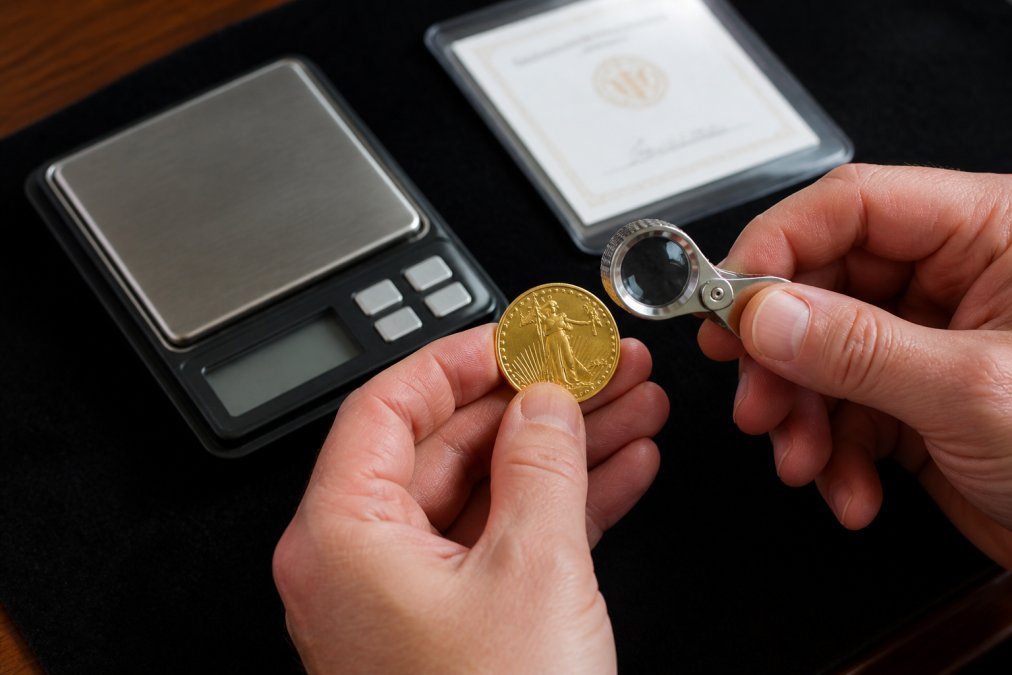
Weight Verification, Assay Certificates and Counterfeit Detection
Start with weight. A one-ounce gold coin should weigh one troy ounce, about 31.1 grams; use a jeweler's scale accurate to 0.01 grams and weigh the item against its stated specification.
Next, check dimensions. Counterfeiters often get the weight right but the diameter or thickness wrong, because matching density and size simultaneously is difficult. Inexpensive calipers settle the question quickly; a genuine coin should match the manufacturer's published diameter and thickness within a small tolerance.
Then look for documentation. An assay certificate from a refiner or mint confirms the metal's weight and purity. Bars from major refiners ship sealed in tamper-evident packaging with a matching certificate; a bar arriving loose with no paperwork is a warning sign.
For an added layer of confidence, a Royal Canadian Mint specification page lists the exact weight, diameter, and thickness of its bullion coins, so you can verify a coin against the manufacturer's own figures rather than a dealer's description.
Counterfeit Detection for Beginners
Counterfeit gold is usually tungsten or gold-plated base metal, and the fakes reaching online buyers often pass a casual look. A few practical checks catch most of them.
Magnetic test. Gold is not magnetic, so a strong magnet should not stick to a genuine coin or bar. A slight attraction is a red flag, though some counterfeiters use non-magnetic metals, so passing is not proof of authenticity.
Ping test. A genuine gold coin produces a clear, sustained ring when tapped; a counterfeit often sounds dull or flat. This is a quick screen, not definitive, and works best with a known genuine coin for comparison.
Acid test. A small drop of nitric acid on a scratch mark reacts with base metal but not gold. This test is destructive, so use it only on items you already own, never on a coin you might return.
Sigma or XRF testing. A precious metals verifier, sometimes called a sigma tester, measures electrical conductivity and can flag a tungsten core without damaging the item. Some local coin shops and pawnbrokers offer this for a small fee, and it is the most reliable non-destructive check available to a retail buyer.
Vetting the Dealer Before You Pay
Authenticity starts with the seller. A dealer who publishes buy-back prices, provides a physical business address, and has a track record of reviews is a lower-risk counterparty than an anonymous marketplace listing. Ask whether they source directly from a mint or refiner and will include the assay certificate and invoice with the shipment.
What to Do When Your Order Arrives
Weigh and measure the item before breaking any seal. If the packaging is tamper-evident, check that the seal is intact and the certificate matches the item.
Gold Bullion Storage Options: Vaulting, Home Safes and Everything Between
Taxes, RRSP Eligibility and What Buying Gold Bullion in Canada Online Really Costs
GST/HST on Investment-Grade Precious Metals
Capital Gains on Bullion Sales
RRSP and TFSA Eligibility for Gold
What the Online Price Actually Includes
Shipping, Insurance and Order Tracking: How Your Metal Arrives
Frequently Asked Questions
Is it safe to buy gold bullion online?
It can be, provided the dealer ships with insured shipping and provides order tracking. Check that the seller lists a physical business address, publishes a buy-back program, and issues an assay certificate with each order. Pay by methods that give you a paper trail, and confirm the package requires a signature on delivery. Buying gold bullion online carries the same risks as any high-value purchase, so the dealer's shipping insurance and return policy matter as much as the price.
What should I look for when choosing an online bullion dealer?
Start with transparency: a dealer should show the spot price it is quoting against and the market premium it adds, so you can compare on equal terms. Then check whether the product listing states gold content, weight verification method, and whether an assay certificate is included. Storage fees, insured shipping terms, and a written buy-back program separate a serious bullion dealer from a reseller. A site that explains these plainly is usually set up for first-time buyers too.
How do I verify the authenticity of gold bars and coins?
Weigh the item against its stated troy ounce weight, since gold has a fixed density and a fake will be off. Read the stamped purity, such as 99.99% purity on a Canadian bullion coin, and match the serial or mint mark against the assay certificate. A magnet should not stick to gold. For coins, compare the radial lines and fine detail against a known genuine piece. If anything feels wrong, have a bullion dealer test it before you resell.
What are the tax implications of buying gold bullion?
In Canada, bullion coins and bars of high purity are generally exempt from GST/HST, which is one reason physical gold is popular here. Capital gains rules still apply when you sell at a profit, and the Canada Revenue Agency treats precious metals as capital property in most cases. Some registered plans allow specific bullion products, so confirm eligibility before assuming a purchase qualifies. Talk to an accountant about your own situation.